Search

Working for Illinois Caucus

House Downstate Democrats work for the good people of Illinois

Tag

15-Health

Bill would require faster reporting of opioid dispensing

http://bit.ly/2t62Kku

Pharmacies in Illinois would have less time to report dispensing opioid medications and other controlled substances under a bill making its way through the General Assembly.

The House Human Services Committee on Wednesday advanced a bill that would require pharmacies to file those reports by the end of the business day on which controlled substances are dispensed. Current law gives them until the end of the following business day.

“It ensures that medical providers have a complete picture of what their patients are taking so that they’re not over-prescribing opioids to patients who misuse or, actually, frequently then sell the fraudulent medication,” Rep. Katie Stuart, D-Edwardsville, the bill’s sponsor, told the committee during testimony.

She said the bill is an attempt to prevent what she called “doctor shopping.” Under current law, she said, people trying to obtain illicit doses can visit multiple doctors over a 48-hour period and receive multiple prescriptions before any of those prescriptions are reported.

In an interview after the hearing, Stuart said the nation’s opioid epidemic has affected nearly every community, including her home community of Edwardsville.

“Some areas in my district and the surrounding area have really been hit hard, so I’ve been just talking to folks, trying to approach it from every angle that we can and look at every way we can stop this,” she said.

Although the bill passed out of the committee unanimously, some members suggested it might need technical amendments to define what constitutes a business day, and how that would apply to pharmacies that are open 24 hours a day.

E-ISVMA All,15-Health,01-All No Sub,17-Energy,02-Pol,19-Legal,24-ILGA,010-Inoreader Saves,16-Econ,25-Working,26-Delivered,RKPRS HL,HL,HL New

via Effingham Daily News

February 6, 2019 at 10:28PM

Bill would require faster reporting of opioid dispensing

http://bit.ly/2t62Kku

Pharmacies in Illinois would have less time to report dispensing opioid medications and other controlled substances under a bill making its way through the General Assembly.

The House Human Services Committee on Wednesday advanced a bill that would require pharmacies to file those reports by the end of the business day on which controlled substances are dispensed. Current law gives them until the end of the following business day.

“It ensures that medical providers have a complete picture of what their patients are taking so that they’re not over-prescribing opioids to patients who misuse or, actually, frequently then sell the fraudulent medication,” Rep. Katie Stuart, D-Edwardsville, the bill’s sponsor, told the committee during testimony.

She said the bill is an attempt to prevent what she called “doctor shopping.” Under current law, she said, people trying to obtain illicit doses can visit multiple doctors over a 48-hour period and receive multiple prescriptions before any of those prescriptions are reported.

In an interview after the hearing, Stuart said the nation’s opioid epidemic has affected nearly every community, including her home community of Edwardsville.

“Some areas in my district and the surrounding area have really been hit hard, so I’ve been just talking to folks, trying to approach it from every angle that we can and look at every way we can stop this,” she said.

Although the bill passed out of the committee unanimously, some members suggested it might need technical amendments to define what constitutes a business day, and how that would apply to pharmacies that are open 24 hours a day.

E-ISVMA All,15-Health,01-All No Sub,17-Energy,02-Pol,19-Legal,24-ILGA,010-Inoreader Saves,16-Econ,25-Working,26-Delivered,RKPRS HL,HL,HL New

via Effingham Daily News

February 6, 2019 at 10:28PM

Crosby: ER nurse from Aurora partners with state legislator on bill to prevent hospital violence

https://trib.in/2TGVtTe

Sonja McCarthy had no idea the day state Rep. Stephanie Kifowit (D-Oswego) made one of her routine “constituency outreach” stops at her Aurora home in the summer of 2016 that the two would end up working together on a bill to reduce workplace violence.

McCarthy, an emergency room nurse who had just gotten off her overnight shift at Advocate Good Samaritan Hospital in Downers Grove — and, like Kifowit, a fellow Marine — was awakened by that late morning knock on her door. But the two women quickly fell into a passionate conversation when her state rep asked what issues were of most concern.

McCarthy knew a lot about workplace violence. Not only had she run into it time and again as a level one trauma nurse at Advocate Good Samaritan for 13 years, she was a founding member of the group’s committee to address an issue that was starting to be recognized as a critical problem in the industry.

The conversation went well. And because of this meeting, Kifowit was instrumental in passing a bill that would raise the penalty for assaulting a healthcare worker to a felony.

While hospitals statewide already have or are working to comply with the new law, the consensus is there is no way you can stop violence from happening. As one official noted, when you have hundreds of patients in a building with thousands going through the ER a year, “things are going to happen.”

But the idea is to continually work toward updating policies, reviewing them and giving employees as much feedback as possible to assure them they will be kept as safe as possible, officials insist.

McCarthy, who estimates she’s put “thousands of hours” into this issue, hopes to one day train others in how to recognize pre-violence indicators and de-escalate situations, as well as work with hospitals on appropriate documentation that, for example, would more quickly denote a patient’s history of violence.

While attacks, particularly verbal assaults, are still under-reported, likely because there is still fear among workers that speaking out could jeopardize their careers, McCarthy is encouraged by “significant progress” in defining the problem.

And, while she recognizes there “is still work to do when it comes to how best to report and track the violence,” she describes it “as such a proud moment” when this bill became law.

“We no longer consider it part of the job … that it’s not OK if this person is violent towards me,” she said. “I really do see how far we have come.”

dcrosby@tribpub.com

Twitter @dencrosby

01-All No Sub,02-Pol,15-Health,17-Energy,19-Legal,24-ILGA,25-Working,26-Delivered

City: Aurora,Region: W Suburbs,Opinion

via Beacon News Opinion – Aurora Beacon-News https://trib.in/2D6gBgz

January 13, 2019 at 07:12AM

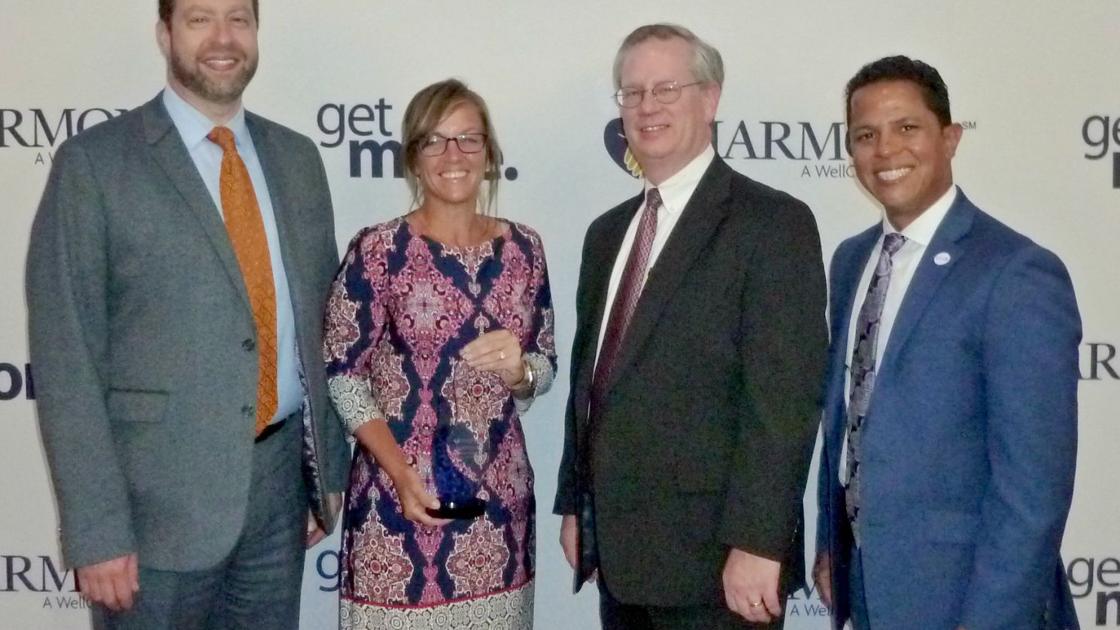
State Rep. Katie Stuart Receives CommUnity Hero Award from Harmony Health Plan

https://ift.tt/2IAGF4t

Southern Illinois CommUnity Health Heroes Honored by Harmony Health Plan

CHICAGO (Oct. 3, 2018) —Harmony Health Plan, Inc., recently honored five local champions in Southern Illinois who are dedicated to helping their community members live better, healthier lives.

The 2018 Harmony CommUnity Health Hero awards, now in their second year, were based on nominations received from throughout the region and were distributed based on five categories including healthcare, government and policy, education, advocacy and community support. The 2018 winners are:

Rep. Katie Stuart (Government and Policy) – Illinois State Rep. Katie Stuart, (D-112), Evansville. Prior to being elected to serve the 112th District in 2017, Stuart was an instructor in the department of mathematics and statistics at Southern Illinois University-Edwardsville, where, in addition to teaching mathematics courses, she mentored and supervised the next generation of mathematics educators. Her 25-year career in the classroom also placed her in local high schools and middle schools. In the Illinois house, Stuart has been a passionate advocate for improving the lives of working families. She serves on the higher education, elementary and secondary education – licensing, administration and oversight, government transparency, elections and campaign finance, and business incentives for local communities committees. According to her nomination, “Rep. Stuart believes in service and integrity and that to serve our state, she has to serve her community and represent her community’s values.”

Kim Johnson (Healthcare) –Kim Johnson, community education coordinator, Hospice of Southern Illinois, Inc., Belleville. Johnson is passionate about the work she does for Hospice of Southern Illinois and the relationships she has built with many community partners since joining the organization in 2008. She attributes her years with the U.S. Marine Corps for her persistence that she now puts into ensuring members of the community have a healthcare power of attorney and any other resources they need, even if that means making sandwiches for local food pantries. “Kim’s compassion and caring nature gives great comfort to others in time of need. She is strong, compassionate, caring and supporting all rolled up into one,” stated her nominator.

Judith Ann Harris Johnson (Education) – Judith Ann Harris Johnson, board member of Springfield School District 186, Springfield. Harris Johnson has represented the community in the Springfield school district since 2001, including serving as its board president from 2005-2006. She firmly believes educating children is the most important mission of any education system. Her career has stretched over a 40-year span in the Illinois state senate having served as the first female assistant sergeant-at-arms and as a legislative assistant to several state senators. Harris Johnson is a role model who believes in being involved and connected with the community. Her civic memberships include Union Baptist Church, Family Service Center of Sangamon County, and as a current board member-past president and secretary of the Springfield Branch of the NAACP. Her nominator stated, “What I admire the most about Judy is her passion when it comes to advocating for the population she represents. With her work on the board of education, and the various boards and committees she has served on, Judy continues to be been a strong voice for those who are often underrepresented.”

Lynn Hatfield (Advocacy) – Lynn Hatfield, RN, executive director, Living Independently Now Center (LINC), Inc., Swansea. As part of LINC’s management team, Hatfield provides skilled supervisory and leadership support to direct service staff ensuring that LINC’s programs and services meet or exceed the needs of their consumers and grant objectives. During the past 20 years, she has developed a solid network of community and governmental agencies, widening resources and opportunities for people with disabilities. Hatfield also serves on the board of directors of Illinois Network of Centers for Independent Living, a statewide association of Centers for Independent Living. Her ultimate goal is to help build a stronger community through education, advocacy and service. “Through LINC, Lynn empowers persons with disabilities to live independently and to promote accessibility and inclusion in all areas of life,” according to her nomination.

Bikers Against Child Abuse (BAC) (Community Support) – Bikers Against Child Abuse (BACA), Metro East Illinois Chapter. Founded in 2005, the Metro East Illinois chapter of Bikers Against Child Abuse was the first chapter in Illinois. Its founder, who goes by the biker road name of M&M, has worked at all levels of the organization to support its mission of “empowering abused children to not be afraid of the world in which they live.” In addition, M&M has held positions at the chapter and state levels of president, treasurer, secretary, child liaison, international events coordinator, and is currently the international training officer. In this position, she travels all over the world to speak with and help BACA Chapters and their membership learn everything from how to interact with abused children to running a not for profit organization. “Our mission is to help the children and their families learn how powerful they can be. Our presence will be available as long as the child needs us.”

“Harmony Health Plan is proud to recognize these outstanding individuals whose tireless efforts and dedication have helped so many access vital services and resources. Their contributions enrich our local communities and help our members live better, healthier lives,” said Chuck Beeman, Illinois state president for WellCare.

All honorees received a $500 donation from Harmony Health Plan to the charity of their choice.

00-Pol RT,15-Health,19-Legal,25-Working,26-Delivered

Region: Metro East,News,City: St. Louis, MO

via http://www.stltoday.com – RSS Results in pr/news of type article https://ift.tt/2zOPm8k

October 3, 2018 at 06:56PM

Hospice care gets a boost from legislation

https://ift.tt/2CQM87S

By Marney Simon | Enterprise Staff


Patients in need of in-patient hospice care now have more options in Illinois, following a change in state law that notably will add services to the Joliet Area Community Hospice (JACH).

Last month, Gov. Bruce Rauner signed legislation introduced in the House by State Representative Natalie Manley (D-Joliet) and the Senate by State Senator Jennifer Bertino-Tarrant (D-Shorewood), increasing the capacity of hospice inpatient units from 16 to 20.

The change was at the request of Mary Sheehan, CEO of JACH, and was supported by the Illinois Hospice and Palliative Care Organization. Both the hospice and the state’s professional organization are committed to promoting palliative and enhancing end-of-life care through education, advocacy, technical and supportive services.

Manley and Sheehan announced the change at the hospice in late August.

JACH cares for a total of 320 patients in eight counties, including those inside the 16-unit inpatient hospice in Joliet. Prior to the new legislation, the limitation meant only 240 beds were available statewide for in-patient care, a number that wasn’t reaching the need. While JACH is staffed around the clock, there have at times been a waiting list.

“We have had a lot of growth, and with that growth comes the need for more inpatient care,” Sheehan said. “The inpatient level of care is for patients who are too sick to be at home, they don’t want to be in a hospital most of the time, and they need their pain and symptoms managed. They don’t want to die at home, sometimes there are children in the home and they don’t want to be there for that.”

Sheehan and Manley said they couldn’t account for why there are bed limits in the state, but hope this is the first step to adding even more beds for inpatient care in the future.

The change is especially close to Manley, whose mother passed away at JACH in July of last year.

“It is the one thing that we all have in common, is that we will eventually at some point lose somebody who is very dear to us,” Manley said. “My mother spent the last few days of her life here, being cared for in a way that I want every person to have the opportunity to have their mother cared for in that way. Staff is amazing, they not only cared for my mother, they cared for my brother and sister and I, my mother’s sister… The professional staff, the administration, they could not have been more supportive.”

The increase statewide from 16 to 20 beds per facility means the total capacity for hospice beds will rise from 240 to 300 beds.

The number of patients in hospice care is growing. At JACH alone, the average number of patients cared for each day has increased more than 63 percent since 2016.

Sheehan noted that hospice is not a place where people give up on life, but rather, is an option for those who are prepared to die on their own terms, and to educate families on how to care for their terminally ill loved one.

“People think hospice is giving up. It’s not, at all. People think there’s no hope, and that’s not true, it’s the opposite, we just hope for different things,” Sheehan said. “We want people to be in charge of their life and their death. Our perception is, we’re living every day, we’re not dying every day. We’re living every day until we die, and we want that to be comfortable.”

JACH also provides a pediatric hospice program.

Hospice treats the physical, emotional and spiritual needs of a patient and their family, including a bereavement program which follows family members for 13 months after a patient passes away.

“We’re all going to leave this earth at some time, and we want to make it as pain free and as dignified as possible,” Manley said. “The Joliet Area Community Hospice team made that possible for my mother, and I’m sure the other hospice homes in the state do the same. It’s a great day and I thank the governor for signing the bill and letting us expand our capacity to help people.”

JACH, a not-for-profit United Way agency, opened the first free standing hospice home in the state of Illinois in 2004. The organization has provided compassionate, professional hospice and palliative care to over 30,000 terminally ill patients and their families since 1982. In just the past two years, JACH provided more than $1.3 million in charity care, community bereavement programs, unreimbursed pediatric hospice and palliative care, and community outreach.

The hospice is funded via Medicare, Medicaid and insurance payments, as well as through private donations.

The hospice will add on to their current building to support the new beds. The plan includes building space large enough to accommodate eight additional beds, for potential future changes in the law. The renovation plans will also include adding a new chapel and overall upgrades to the existing facility. Sheehan said the constriction is expected to cost roughly $3.5 million, with anticipated ground breaking next spring and completion in late 2019 or early 2020.

JACH serves patients in greater Will, Grundy, LaSalle, Livingston, and Kendall counties along with portions of Cook, DuPage and Kankakee counties.

00-Pol RT,15-Health,25-Working,26-Delivered

Local,Region: South Suburbs,Region: Joliet

via Lockport/News – Bugle Newspapers https://ift.tt/2nPUiWC

September 12, 2018 at 12:33PM

Blog at WordPress.com.

Up ↑