Search

Working for Illinois Caucus

House Downstate Democrats work for the good people of Illinois

Tag

25-Working

Q-C area state Rep. Michael Halpin named to Pritzker’s transition team on jobs, economic opportunity

https://ift.tt/2rk7ylb


Democratic Rep. Michael Halpin of Rock Island has been chosen by Illinois Democratic Gov.-elect J.B. Pritzker to join a transition team focused on job creation and expanding economic opportunities, according to a Monday news release.

“As state representative, I’ve worked to encourage economic development in a way that supports the unique goals of business owners, labor unions, local governments and working families in the Quad-Cities region,” Halpin said in a statement. “I look forward to continuing these conversations with stakeholders from across the state, so that together we can lift up the middle class while enacting policies that help businesses grow.”

Subscribe to Breaking News

Pritzker, who handily beat Republican Gov. Bruce Rauner last month, has announced dozens of appointees to head various transition teams over the past few weeks. One of his chief campaign promises has been to address many of the “kitchen table issues” that Illinois residents are concerned with, often pointing to his central issue to change the way income taxes are collected in the state. Pritzker takes office Jan. 14.

Halpin is one of 36 people on the transition team. Also appointed were Hispanic Information Technology Executive Council President Omar Duque, Director of Research Park at the University of Illinois Laura Frerichs, Illinois Medical District CEO and Executive Director Dr. Suzet McKinney and Chicago Federation of Labor President Bob Reiter.

Subscribe to Breaking News


01-All No Sub,02-Pol,19-Legal,24-ILGA,25-Working,26-Delivered,05-Z

Region: Northern,City: Quad Cities,News,Region: QC

via qctimes.com – RSS Results in news of type article https://ift.tt/2RzcEpi

December 3, 2018 at 07:43PM

Democratic legislators from St. Clair, Madison counties will be mostly women by January

https://ift.tt/2E8pTue

For 13 years, Dan Beiser was the state representative for the 111th Legislative District, around the Alton riverbend. When he resigned in December of 2017, Monica Bristow took his place and raised the number of female legislators from St. Clair and Madison County to three.

Bristow, along with state Rep. LaToya Greenwood, D-East St. Louis, and state Rep. Katie Stuart, D-Edwardsville, will be joined by one more metro-east woman in the legislature when Rachelle Aud Crowe is sworn into the state senate.

From 2009 through the end of 2016, all of the legislators from the metro-east were men.

“I think women are more nurturing, we’re more prone to negotiating and I think we’ll see a different culture in the state House,” Bristow said.

In 2016, the gender makeup of metro-east state legislators began to balance out. Eddie Lee Jackson was succeeded by Greenwood. Stuart defeated Dwight Kay. Beiser was replaced by Bristow when he stepped down in 2017.

Seven of the 10 metro-east legislative seats in St. Clair and Madison counties are filled by Democrats. And when Crowe succeeds Haine in January, a majority of the metro-east Democratic legislators in Springfield will be women.

“I wouldn’t say it was intentional as in that only females were considered (in 2016) because I know that is not the case, but I think it’s a great result,” Stuart said.

“I think … we need to realize that women need a voice and minorities of all ilk, based on religion, race and everything else need to be appropriately represented everywhere — CEOs, government positions and teaching and everywhere else,” Stuart added.

492A0144.jpg

State Reps. LaToya Greenwood, D-East St. Louis, and Katie Stuart, D-Edwardsville, applaud during a legislator recognition during the 2018 veto session.

Joseph Bustos jbustos@bnd.com

The metro-east has elected women to the legislature in the past.

State Rep. Wyvetter Younge, a Democrat from East St. Louis preceded Jackson in the 114th District. She served from 1975 through 2008. Evelyn M. Bowles served in the state senate from 1994 to 2003 before being succeeded by Haine.

“It’s not new or unprecedented, just for some reason we had had mostly male legislators and now we have a majority female from the metro-east on the Democratic side,” said state Rep. Jay Hoffman, D-Swansea.

Hoffman said that’s more refection of their quality as candidates than their gender. But their personal perspective on issues like equal pay for equal work will influence the debate.

“I’m happy with the talent, whether they’re men or women, that all of these new legislators are going to bring to the table,” Hoffman said.

Women are set to make up 36 percent of the general assembly when the next class of legislators is sworn in. That is up from 35 percent in 2018.

“I’m very excited about women being included and having a seat at the table when it comes to issues that affect us, because we more times than not are the solvers. So we know how to solve problems,” Greenwood said. “This helps us have a greater platform on issues that affect all of us, not only in the metro-east, but all over the state of Illinois. Not just women’s issues, but issues in general.”

In the 100th General Assembly, which adjourned its 2018 session on Thursday, there are 15 women in the state senate and 47 women in the House.

When the next general assembly is sworn-in, there will be 20 women in the senate and 44 women in the House.

“I think we’re just starting. I’m very excited to be a part of this. When I’m at the new member training and I look around, there are a lot of females in the room,” Crowe said. “There’s an instant camaraderie and most of us are moms and we all know what we’ve been through, through this campaign season. I do think this is just the beginning.”

Illinois has been closer to gender balance than other states. In 2018 women made up 25.8 percent of state legislators in the United States, according to data compiled by the National Conference of State Legislatures.

In 2018, the Illinois legislature had the sixth highest percentage of women. Arizona and Vermont had the highest with each having 40 percent women, National Conference of State Legislatures data shows.

Even though Illinois had a higher percentage of women in its legislature, the capitol building was hit with its own Me Too sexual harassment scandals. Complaints led to state Rep. Lou Lang, D-Skokie, resigning from his leadership position in the state House, and the ouster of Tim Mapes, the chief of staff of Speaker Mike Madigan. Lang was ultimately cleared of harassment allegations.

Whether having more women in the office helps prevent harassment is speculation, Crowe said.

“What prevents it is awareness, and maybe when you look around at who is leading that issue of awareness, those are females for the most part,” Crowe said.

The Center for American Women and Politics at Rutgers University does ongoing research on women’s participation in American politics. The influence of women and minorities make a provable difference in state legislatures, said its director, Debbie Walsh.

“We know that it matters to have more women in office, to have more diversity in office,” she said. “People bring all of their life experiences to the table when they’re serving, and it shapes their priorities and it shapes how they’re going to lead.”

Walsh said women would have different outlooks on child care and health care.

“They might see the differential impact a policy might have on women or single moms or kids that their male colleagues might not see,” Walsh said. “It’s not that their male colleagues won’t be supportive, it’s just that they won’t see it. It might not occur to them.”

Ultimately the goal would be gender parity among elected officials, Walsh said.

“It’s still not 50 percent, which is where it should be,” Walsh said. “Women make up 51 percent of the population. It would be nice if women were 50 to 51 percent of the elected officials (and) if people of color were well-represented. Gay, straight, race, ethnicity, religion — all of that diversity enriches our democracy.”

492A0054.jpg

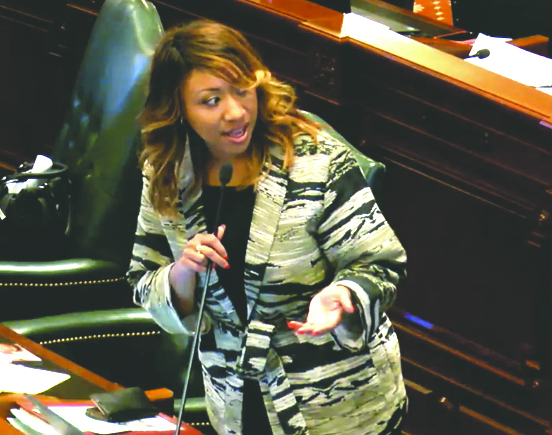
State Rep. Monica Bristow, D-Godfrey, speaks on the House floor during the 2018 legislative veto session.

Joseph Bustos jbustos@bnd.com

Illinois has programs to encourage and train women to run for office. The Republican Party in Illinois offers the Lincoln Series, while the Democratic Party has the Illinois Women’s Institute for Leadership Training Academy. Loretta Durbin, wife of U.S. Sen. Dick Durbin, is a past president and founding board member of the later.

Putting more women into elected offices, however, has been an incremental change.

Illinois went from being ranked 16th in the country in 2010 to seventh in 2011 in percentage of women in the legislature. That happened when Illinois had a net gain of five women.

“It is a slow process of getting more women to run and having more women participate in the process,” Walsh said.

Nationally, 2018 produced a record number of female candidates for state legislative seats, Walsh said. She added the Democrats among them benefited by the support of Emily’s List, which raises money for women candidates. Republican women need something comparable, Walsh said.

The state GOP has run women candidates in the metro-east, but they were unsuccessful. Katherine Ruocco, in 2014, and Tanya Hildenbrand, in 2018, both ran for state senate seats in the 57th District, but ultimately lost in general elections. Ruocco also challenged Hoffman in the state House of Representatives in 2016.

In 2018 Wendy Erhart, of Maryville, had the support of the Illinois Republican Party when she campaigned in the 112th State House District. Erhart ultimately lost to Kay in the primary.

Walsh says continuing the trend toward more gender parity depends on more Republican women getting elected.

“We will never get to political parity if we’re only electing more Democratic women,” Walsh said. “I think the (Republican) party has to do more to recruit and support women to run for office … The party has to make it a priority. They have to really value getting more Republican women in office and that means recruiting them, supporting them and grooming them. And it might mean stepping in some primaries and running women in winnable races and winnable districts.”

010-Inoreader Saves,01-All No Sub,02-Pol,19-Legal,25-Working,26-Delivered

via bnd

December 1, 2018 at 08:29AM

Rep. Stuart to host 2nd annual Holiday Open House, collect canned goods

https://ift.tt/2FNugwl

COLLINSVILLE – To give all residents an opportunity to visit her local office and voice their concerns, state Rep. Katie Stuart, D-Edwardsville, will be hosting her second annual Holiday Open House

Continue Reading

02-Pol,13-GBI,25-Working,26-Delivered

Region: Metro East,City: Alton,Feeds,News,Southern

via RiverBender.com News https://ift.tt/20GIkqu

November 28, 2018 at 10:32AM

Teachers seek seats on State Board of Education

https://ift.tt/2DXQUQH

State Rep. Litesa Wallace (D-Rockford) talks about the importance of having teachers on the State Board of Education. “Typically when we are compiling boards related to a particular profession, we seek individuals from that profession because of their expertise,” Wallace said. (BlueRoomStream.com

Three teachers could soon earn spots on the nine-person Illinois State Board of Education.

The state Senate will consider the measure after the House of Representatives overrode the governor’s veto of the proposal.

Under the legislation proposed by state Rep. Linda Chapa LaVia (D-Aurora), a teacher from Cook County, one from the collar counties around Cook, and one from central or southern Illinois would all be assured positions on the governing body.

“Don’t you think it would be very prudent of us to make sure that somebody who knows about education, that is certified in education, that has the pedagogy in education is able to sit at the table to make sure they are representing the whole state of Illinois in terms of teaching communities?” Chapa LaVia asked when questioned on why she was looking to limit governors’ hands on appointments to the ISBE.

“I don’t see the point of doing this and tying the executive branch’s hands,” state Rep. Peter Breen (R-Lombard) said.

The proposal has the backing of the Illinois Federation of Teachers, the Chicago Teachers Union and other educational labor groups seeking to change the composition of the State Board of Education.

“There’s not been any need identified for this,” Breen said. “There is no need to tie the hands of Governor Pritzker and the hands of every other governor to come from this point forward.”

State Rep. Litesa Wallace (D-Rockford) said she knew of no other professions where a governing body of people not in the industry could make major decisions affecting the industry.

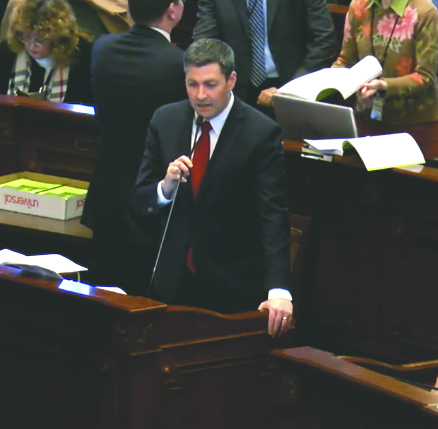
State Rep. Peter Breen (R-Lombard) questions the need for changing the make-up of the Illinois State Board of Education. “There is no reason to tie the hands of Gov. (J.B.) Pritzker and the hands of every other governor to come from this point forward,” he said. (BlueRoomStream.com)

“Typically when we are compiling boards related to a particular profession, we seek individuals from that profession because of their expertise.” Wallace said. “… We have to be clear in the fact that business people are not always educators. Other professions are not always educators.”

She asked her peers on the House floor Nov. 14 if they would want to take advice and instruction from individuals who have never worked in that profession.

The House overrode the governor’s veto in an 85-27 vote. All 27 votes against the override came from Republican members of the House.

There were, however, 21 Republicans who supported the override. They were: Steven Andersson of Geneva, Terri Bryant of Murphysboro, Tim Butler of Springfield, C.D. Davidsmeyer of Jacksonville, Mike Fortner of West Chicago, Norine Hammond of Macomb, Sheri Jesiel of Winthrop Harbor, Jeff Keicher of Sycamore, Michael McAuliffe of Chicago, Tony McCombie of Savanna, Charles Meier of Okawville, Bill Mitchell of Forsyth, David Olsen of Downers Grove, Lindsay Parkhurst of Kankakee, Steven Reick of Woodstock, Dave Severin of Benton, Ryan Spain of Peoria, Grant Wehrli of Naperville, David Welter of Morris, Barbara Wheeler of Crystal Lake and Christine Winger of Wood Dale.


kbeese@chronicleillinois.com


25-Working,26-Delivered

Feeds,News,Region: Statewide,State

via Chronicle Media https://ift.tt/2nXDppq

November 26, 2018 at 12:07PM

Salary history, teacher wage bills to come back next year

https://ift.tt/2TLnycU

SPRINGFIELD — During the first week of the Illinois General Assembly’s veto session, lawmakers voted to override Gov. Bruce Rauner’s vetoes or amendatory vetoes on dozens of bills.

At least two high-profile bills didn’t get override votes the first week: a bill to set a new minimum salary for Illinois school teachers and legislation to prohibit employers from asking for a salary history from job applicants.

Lawmakers can no longer take action on those bills during the remainder of the veto session, which wraps up next week. Here’s what’s in store for them as Democratic Gov.-elect JB Pritzker prepares to take office next year.

Minimum teacher salary

Sen. Andy Manar, D-Bunker Hill, said he’s not giving up on the idea of increasing the minimum salary that every school district in the state will have to pay their teachers.

“There have been ongoing conversations that haven’t stopped since going back to May when we passed the bill,” Manar said. “Those are going to continue. I would expect to re-file, if not a bill that’s exactly the same, something that’s very similar to what was filed and already passed in the General Assembly.”

The bill that already passed, Senate Bill 2892, gradually raises the minimum salary for teachers to $40,000 starting with the 2022-2023 school year. The current minimum salary for teachers is $9,000, a level set in law 38 years ago.

The bill set a minimum salary for teachers at $32,076 for the 2019-2020 school year. The delayed start of the bill was intended to give school districts time to adjust their budgets to accommodate the higher wage. Manar said that since a new law couldn’t be adopted until next year, he is open to discussing a further extension in the start date for raising the wage.

The bill also called for the minimum wage to be increased each year after reaching the $40,000 threshold to account for inflation.

The bill passed with bipartisan support in both the House and Senate. In the Senate, it got 37 “yes” votes, enough to override a veto. In the House, though, it only got 65 “yes” votes, significantly short of what is needed for an override.

And veto the bill outright is exactly what Rauner did. In his veto message, Rauner said the bill would amount to a “significant unfunded mandate” on school districts and take away local control over salaries. He said that alternatives like pay-for-performance and pay incentives for teachers with prior work experience could increase teacher compensation while preserving local control.

Manar said he’s heard concerns from superintendents about the potential cost.

“They are also at the same time concerned with the crisis of having a teacher shortage in the state,” Manar said.

Manar believes that setting a higher minimum teacher salary will entice more students into the profession.

Manar also said the costs of a higher minimum salary can be offset by the increased funding districts are receiving from the new school aid formula. The formula directs more state money to the neediest districts, the same ones that could face financial pressures from higher teacher salaries.

“I’m simply saying let’s not dismiss the idea that teachers have to be paid well,” Manar said. “Let’s not dismiss the idea that we have to find a reasonable way to pay for it. Let’s try to bring everyone together to get this accomplished.”

Salary history

Twice lawmakers approved a bill that prohibits employers from asking the salary history of an applicant. Twice Rauner used his amendatory veto powers to make changes to it.

Both times, there were not enough votes in the legislature to override Rauner’s changes, but neither did supporters want to accept his changes. Consequently, the bills died.

Rep. Anna Moeller, D-Elgin, said she’s probably going to try again, only this time with someone in the Governor’s Mansion who supports the idea.

“I think we’ll still have substantial support for it; it won’t need as many (votes) to override,” Moeller said.

The bill got 87 “yes” votes in the House, but squeaked by in the Senate with just 31 “yes” votes, just one more than the minimum needed to pass it.

Supporters said the idea was a way to combat gender pay inequality. Women often are paid less than their male counterparts, and allowing an employer to ask for a wage history is seen as a way to perpetuate that wage gap.

Rauner said he agreed that gender pay inequality is an issue that needs to be addressed but said a better way to do it was the way Massachusetts did it. He rewrote the Illinois bill to reflect that.

However, Moeller said she thinks the changes diluted the effectiveness of the bill as Illinois lawmakers wrote it and also weakened existing pay equity laws in the state.

“We don’t want to weaken what we’ve got; we want to strengthen what we’ve got,” she said.

She said supporters want to work with the business community to come to a compromise, but efforts have failed so far.

The Illinois Chamber of Commerce is opposed to the bill, but is willing to talk about it.

“Every time you have a new General Assembly coming in and new leadership in the governor’s office we’re always willing to take a fresh look at things and see if there is some flexibility,” said Chamber president and CEO Todd Maisch. “The reality is there are legitimate reasons to ask for someone’s wage history.”

Maisch said it is “more reasonable” to just ask for a wage history rather than use other methods to obtain the same information.

“There is a marketplace for salary,” he said. “Employers are always going to be interested to make sure that they’re putting a competitive offer on the table, but also not overpaying for a particular skill set.”

Moeller said she expects a new version of the bill next year will mirror what’s been tried before.

“We feel we have a very strong bill, a very good bill,” she said.


Contact Doug Finke: doug.finke@sj-r.com, 788-1527, twitter.com/dougfinkesjr.


00-Pol RT,16-Econ,19-Legal,XHLSN 3,26-Delivered,25-Working,E Moeller,RK Client

Feeds,State

via State News – Journal Star https://ift.tt/2q50IQ5

November 25, 2018 at 06:34PM

House Sponsor Jonathan Carroll Votes to Support Educator Presence on State Board of Education

https://ift.tt/2Tzbj32

State Rep. Jonathan Carroll, D-Buffalo Grove, voted last week to override Gov. Bruce Rauner’s veto of a bill ensuring more educators have a seat on the Illinois State Board of Education (ISBE).

“One of the biggest problems in education is that policymakers write laws without teacher input,” Carroll said. “As a teacher, I believe ISBE needs to include educators on the board so teachers’ perspectives aren’t ignored.”

Carroll voted to enact House Bill 4284, which in addition to requiring the appointment of educators to ISBE, also sets the necessary qualifications for appointees. The legislation would not allow more than one member employed by the same school district to serve on ISBE. The bill received bipartisan support in the House but was blocked by Rauner’s veto. Carroll joined a bipartisan group of lawmakers to override the veto.

“The education system only works when policymakers, administrators, and teachers are all on the same page,” Carroll said. “This bill makes sure that teachers with real-world experience have a seat at the table.”

See also …

Bill Status of HB4284 — 100th General Assembly

^^ MOBILE? USE VOICE MIC ^^

 facebook … 

GET ALERTS on Facebook.com/ArlingtonCardinal

GET ALERTS on Facebook.com/CardinalEmergencies

GET ALERTS on Facebook.com/ArlingtonHeightsCrime

Get updates from The Cardinal ALL NEWS FEEDS on Facebook. Just ‘LIKE’ the ‘Arlington Cardinal Page (become a fan of our page). The updates cover all posts and sub-category posts from The Cardinal — Arlingtoncardinal.com. You can also limit feeds to specific categories. See all of The Cardinal Facebook fan pages at Arlingtoncardinal.com/about/facebook …

Help fund The Cardinal Arlingtoncardinal.com/sponsor

CLEAR SKIES?

 &nbsp

Weather Data for Wednesday, November 21st, 2018

Tags: , , , , ,

&nbsp &nbsp

IMPORTANT NOTE:

All persons referred to as subjects, defendants, offenders or suspects, etc. are presumed to be innocent unless and until proven guilty beyond a reasonable doubt in a court of law.

Try a more powerful search in the box below ...
SEARCH BOX PRODUCES RESULTS FOR The Cardinal — Arlingtoncardinal.com

(POWERFUL SEARCH for The Cardinal, which can be expanded on the results page.)

Where background Wikipedia info/photos are used, original work is modified and released under

CC-BY-SA

.

! MORE NEWS FAST!!! MOST RECENT:
CRIMEBLOG | MOST RECENT: FIREBLOG | SUBMIT NEWS TIPS
::: Health, wellness and fitness gifts! CoolFitnessGifts.com ::: Cubs, Sox caps at ChicagoFanfare.com :::
ARLINGTON HEIGHTS BREAKING NEWS –The Cardinal — Arlingtoncardinal.com

is a breaking news blog with Arlington Heights & Chicagoland emphasis. Early breaking reports may prove to be inaccurate after follow-up investigation, which may or may not be updated in The Cardinal — Arlingtoncardinal.com. For in-depth coverage, please also check the following links for network television, cable news networks and Chicago local media coverage …

Daily Herald | Daily Herald — Arlington Heights | YouTube.com/DailyHeraldClips
Today’s headline videos: FOXNews Video | YouTube.com/FoxNews | Associated Press | The Cardinal

Chicago Area Newspapers

00-Pol RT,09-ILSN,19-Legal,XHLSN 3,25-Working,26-Delivered

News,Region: AH,Region: Suburbs,City: Arlington Heights

via The Cardinal https://ift.tt/2AbqQxb

November 21, 2018 at 11:51AM

Bristow encourages area residents to shop local for Small Business Saturday

https://ift.tt/2QdRGyW

Bristow encourages area residents to shop local for Small Business Saturday

ALTON – As families begin shopping for the holiday season, state Rep. Monica Bristow, D-Godfrey, is encouraging area residents to support the Riverbend region’s local economy by shopping locally on Small Business Saturday, Nov. 24.

“During my time as President of the Riverbend Growth Association, I saw firsthand the meaningful influence that small businesses have in our community,” Bristow said. “Small businesses benefit our local economy and provide employment for our friends and neighbors.”

Saturday, Nov. 24 marks the 9th Annual Small Business Saturday, which was created to help small businesses compete with large retailers between the busy shopping days of Black Friday and Cyber Monday. Bristow is encouraging local residents to shop locally at small businesses this holiday season, as they offer unique goods for gifts, jobs for local residents, and support to local charities and organizations.

In her time as state representative, Bristow has made it a priority to make Illinois more business-friendly by cutting burdensome regulations and developing plans to encourage new businesses to start. One measure Bristow spearheaded, the Illinois Home Grown Business Opportunity Act, was recently signed into law by the governor.

“With my background in business, I made it my mission to come to Springfield and pass policies to reignite our state’s economic engines,” Bristow said. “I encourage local residents to return the enormous support small businesses provide to our community by shopping locally, not just on Small Business Saturday, but throughout the year as well.”

For more information, please contact Bristow’s full time constituent office at 618-465-5900 or RepMBristow@gmail.com.

00-Pol RT,25-Working,16-Econ,26-Delivered

Region: Metro East,City: Alton,News

via News RSS Feed https://ift.tt/2GriCHc

November 21, 2018 at 10:38AM

New vote totals show Democrat pulling ahead in north suburban state rep race previously separated by 1 vote

https://ift.tt/2DBcIAU

Separated by just one vote on election night, newly added Lake County ballots give Democrat Mary Edly-Allen a 373 vote lead over Republican Helene Miller Walsh in the 51st Illinois House District.

Late-arriving mail-in ballots and provisional ballots were added to Lake County vote totals Tuesday evening, the last day for eligible votes to be counted, according to Lake County Clerk Carla Wyckoff.

She said the office waited until 5 p.m. for the last delivery of mail, which could include out-of-town ballots that would be valid if postmarked by Election Day. The district also has a single precinct in Cook County.

Uncertified results show Republican Walsh garnering a total of 25,576 votes, while her Democratic opponent Edly-Allen’s total stands at 25,949.

00-Pol RT,19-Legal,26-Delivered,25-Working

Feeds,News,Region: Chicago,City: Chicago,Opinion

via Home – Chicago Tribune https://ift.tt/1LjWzdx

November 20, 2018 at 07:09PM

With Senate heavyweights Clayborne, Haine leaving, who fills their shoes in Springfield?

https://ift.tt/2DtZLbI

When the new General Assembly is sworn in January, three metro-east state senators who have served several terms won’t be there. State Sens. James Clayborne, D-Belleville, Bill Haine, D-Alton, and Kyle McCarter, R-Lebanon, all did not run for re-election in 2018.

Clayborne and Haine have decided to retire from the legislature, and McCarter decided not to run again and is awaiting confirmation by the U.S. Senate to be the next ambassador to Kenya. McCarter will be succeeded by Republican Jason Plummer.

However, in the Illinois General Assembly’s upper chamber, Clayborne, who served since 1995, and Haine, who served in the state Senate since 2002, were in leadership positions: Clayborne is the outgoing majority leader. Haine is an assistant majority leader.

State Rep. Jerry Costello II, D-Smithton, said he and state Rep. Jay Hoffman, D-Swansea, who have longer tenures in the General Assembly than the remaining metro-east legislators, would have to work to continue the metro-east’s influence in Springfield. Costello said Clayborne and Haine being in their positions helped make sure the metro-east and Southern Illinois were at the table and voices heard.

“I would tell you it would be shallow to think it would not have an effect, but it means people like myself or Jay, who’ve been around a little longer, Jay quite sometime around longer than I have, (are) going to have to make sure we step up and try to fill some of those shoes,” Costello said. “Obviously majority leader Clayborne and Senator Haine will be sorely missed. They’re terrific people who have brought a lot to the metro-east.”

Haine, who decided not to run again after being diagnosed and undergoing treatment for blood cancer, is being succeeded by Democrat Rachelle Aud Crowe. Clayborne is being replaced by Democrat Christopher Belt.

Hoffman does serve as majority conference chairman in the House, and Costello serves as the chairman of the Downstate Democratic Caucus.

“Those are some folks who were advocates for the metro-east and had the knowledge and seniority to get things done. There will be some big shoes to fill,” Hoffman said of Haine and Clayborne. “Sometimes it’s tough to replace people, but no one is irreplaceable. It’s good we’re going to have fresh ideas with some of the new people coming in, and are coming in from different walks of life.”

Hoffman a leader also makes sure other legislators who joined recently, such as state Rep. LaToya Greenwood, D-East St. Louis, state Rep. Katie Stuart, D-Edwardsville and state Rep. Monica Bristow, D-Godfrey, are able to bring up concerns for their districts.

“A leader will make sure that the folks in their area that represent their area will have a voice when they’re just getting into the general assembly,” Hoffman said. “I hope I’ve been helpful to LaToya, and Katie, and now Monica, I know the same will be true for the leadership in the senate, who will make sure if there are issues that need to be addressed in a local area that they’ll help Chris (Belt) and Rachelle (Aud Crowe) address them. I know Bill and James will be helpful, even though they’re not elected, in just navigating the legislative process.”

Hoffman added the metro-east legislators will be able to accomplish more for the region as long as they continue to work together, no matter the party.

“You’re always stronger if you can have a coalition like that that can advocate for an area,” Hoffman said. “Not all places in Illinois have that. We’re lucky that we have a significant delegation.”

The state Senate also adopted resolutions honoring Haine’s and Clayborne’s retirements.

“It is a tremendous loss to the metro-east just in institutional knowledge,” said state Sen. Paul Schimpf, R-Waterloo, who succeeded Republican Sen. David Luechtefeld, R-Okawville, who chose not to run in the 2016 election.

Luechtefeld served from 1995 to 2017 and had been a deputy and assistant Republican leader.

“I respect both Senator Haine and Senator Clayborne. I like to think those that are still around have been starting to get a little more experience,” Schimpf said. “I’m hoping I could pick up some of the slack for them. I got myself appointed to JCAR, the Joint Committee on Administrative Rules, that’s a tremendously important post. I have a good relationship and really all of our downstate delegation has a fairly good relationship, we all work well together. And we’ll be able to continue to lookout for the interests of the metro-east.”

Senate President John Cullerton said there will be a learning process for Crowe, Belt and Plummer as they come in.

“That exists for anyone when they first start at the capitol. What strikes me is that these senators, just like their predecessors, are grounded in the people and issues of their communities,” Cullerton said in an email.

Cullerton said Clayborne and Haine themselves may have been questioned when they first got to Springfield.

“I’ve got to believe people had the same questions when Senators Clayborne and Haine were first chosen to represent the region. History has proven the wisdom of those choices. And now, from what I know of Senators-elect Belt and Crowe, I believe the people of the region have again shown their wisdom in selecting a new generation of leaders dedicated to aggressively representing the people and interests of the metro-east.”

The Democrats, who will have a supermajority in the state Senate, plan to nominate Cullerton to be Senate president in the next General Assembly. However, other leadership positions, such as leader and assistant leaders have yet to be determined.

Greenwood said there would be another person who will help care for metro-east issues: Gov.-elect J.B. Pritzker.

“What we found out during the campaign trail, is Gov.-elect Pritzker and Lt. Gov.-elect Stratton were in our metro-east area on numerous occasions,” Greenwood said. “More times than I can remember than any other administration that was looking for voters and looking for support in our area. I think that attention will not go away. I’m sure they will continue to support and be concerned about the issues that affect us.”

00-Pol RT,19-Legal,26-Delivered,25-Working

Region: Metro East,Feeds,News,City: Belleville

via Metro East Breaking News, Sports & Crime | https://www.bnd.com/

November 16, 2018 at 01:46PM

Blog at WordPress.com.

Up ↑