Search

Working for Illinois Caucus

House Downstate Democrats work for the good people of Illinois

Tag

06-RK Email 11

House Dist. 43 hopefuls talk term limits, business regulations

https://ift.tt/2OQwUEC

Candidates in the November election vying to represent the state’s 43rd House District said they have different views on term limits and business regulations.

Incumbent Anna Moeller, 46, a Democrat from Elgin, is a former Elgin City Council member who was appointed in March 2014 and elected a few months later. Republican challenger Andrew Cuming, 31, also of Elgin, manages several properties in Elgin and twice ran unsuccessfully for Elgin City Council. Both were unopposed in the primary.


Moeller said she doesn’t believe in term limits. When re-election is off the table, legislators aren’t accountable to voters or party leadership, she said. In states with term limits, legislators also become too dependent on bureaucrats and lobbyists, she said.

“It takes a long time to become an expert, or very skilled, at the job of legislating. You’re working in a very complex organization representing a diversity of needs and views with hundreds of different issues in front you,” she said.

Cuming said he plans to serve a maximum two terms, and supports a six-year term limit for state representatives and a 12-year limit for state senators.

Voters often make choices along party lines, and incumbents always have an advantage, Cuming said. “I agree we have a massive problem with incumbents and built-in bureaucracy,” he said. “When you have the room made for new blood, for people who are not indebted to the system, it opens up a more equal playing field.”

Cuming said he identifies himself as a “Ron Paul Republican.” “I’m socially fairly liberal, fiscally very conservative,” he said.


“I’m a big freedom guy,” he added. “Which means I really believe that people should be allowed their lives as their wish, without interference.”

Moeller said her ideology aligns more with that of her constituents.

“Limited government, limited regulations on businesses that pollute or discriminate against workers,” she said, “that’s libertarian ideology, and I don’t think that represents the area that I live in.”

Cuming said he believes “businesses should be treated far more gently.” Prevailing wage requirements put a huge financial strain on local governments, he said.

Sometimes that can be true, Moeller said, pointing to when she was director of the McHenry County Council of Governments during the emerald ash borer epidemic and worked with unions to ease prevailing wage requirements to remove dead trees.

Moeller said she supports raising wages for workers. “If someone wants to work for a rate and an employer wants to pay that rate, that’s a fair rate,” Cuming said.

Moeller introduced a bill, vetoed by Gov. Bruce Rauner, that would prevent employers from asking job candidates their salary history for the job. Cuming said he supports that — advocates say it would narrow the gender pay gap — but called “excessive” the bill’s fines of up to $10,000.

Cuming pledged to donate his state government salary to charities in Elgin, and — like Moeller — said he won’t take pension and health care benefits from the state.


00-Pol RT,06-RK Email 11,19-Legal,25-Working,26-Delivered

Feeds,Region: AH,Local,Region: Suburbs,City: Arlington Heights,Suburbs

via DailyHerald.com > Local News https://ift.tt/174gVno

October 8, 2018 at 04:58PM

The push is on to override the veto of House Bill 4163

https://ift.tt/2zu8BUC

Podcasts

The push is on to override the veto of House Bill 4163

Photo: Newsradio 1240 & 93.5 FM WTAX


The push is on to override the veto of House Bill 4163

Posted on by joeym

Joey McLaughlin talks with Illinois State Representative Anna Moeller about the move to override the veto of the wage equity act.


More Podcasts

Tuesday, September 25, 201809/25/2018

Joey McLaughlin talks with Illinois State Representative Anna Moeller about the move to override the veto of the wage equity act.

Tuesday, September 25, 201809/25/2018

Joey McLaughlin talks with Illinois Department of Public Health Chief Medical Officer Dr. Jennifer Layden about flu shots.

Tuesday, September 25, 201809/25/2018

Colleges and universities are wrestling with a rise in sexual assault claims, lawsuits brought by those accused of assault and conflicting direction by courts and the federal government on how to handle them.

Monday, September 24, 201809/24/2018

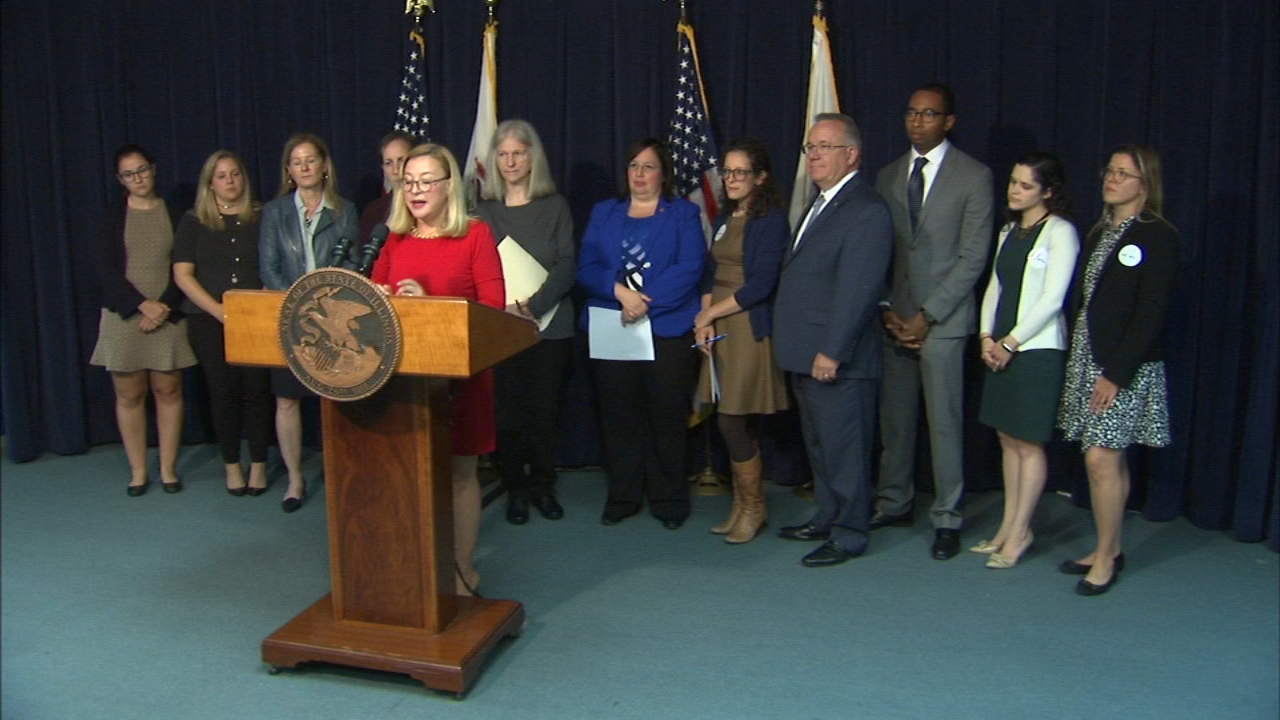
Lawmakers vow to override governor’s salary history bill veto

https://ift.tt/2N093xe

SPRINGFIELD, Ill. (WLS) —

Governor Bruce Rauner is under fire for his veto of a bill that would have tightened up the state’s equal pay law by prohibiting companies from asking someone salary history

Some Democratic lawmakers said that decision will cost the governor a lot of support come Election Day.

The governor vetoed a similar bill last year but this time used an amendatory veto to rewrite the bill.

HB4163 bill is intended to help women narrow the wage gap that pays them, on average in Illinois, 79 cents for every dollar a man earns. The governor’s veto was seen by some as a slap in the face.

"Governor Rauner, in vetoing this bill a second time in two years, has shown who he really is: an out of touch and failed governor who cares very little about the economic welfare of women and families in Illinois," said State Rep. Anna Moeller (D-43rd District), one of the bill’s sponsors.

She and other lawmakers vowed to override the governor’s veto in November.

In his veto message Rauner said, "I am committed to eliminating the gender wage gap and I strongly support wage equality. I noted in my prior veto message that Massachusetts already has established a best-in-the-country approach to the issue of employers inquiring about salary history. I recommended that Illinois model its legal regime on Massachusetts’ model. Unfortunately, legislators again refused to push forward a bipartisan approach that properly balanced the interests of the business community."

"What I can tell you as a small business owner in the hiring process, the only time I’ve ever asked for prior salary is when I’m trying to negotiate paying somebody less," said Alexandra Eidenberg, small business owner.

An attorney who does work for the Illinois Chamber of Commerce, which opposed the bill, said it was too restrictive on businesses in the factors that can be used to set someone’s salary.

"So if you wanted to say a bachelor’s degree is a requirement for this job, since education is not one of the listed items in the bill, that would have to be the only basis for setting the pay. So you couldn’t use seniority or someone’s experience or years and ability you could only use education," said Sara Zorich, partner at Smith Amundsen.

But critics said the governor’s veto makes it easier for employers to get away with discrimination as long as they are working to make progress in eliminating the wage gap.

"There is no defined ‘what is progress,’ there is no defined ‘what is that self evaluation, what does it look like,’ there is none of that defined," said State Sen. Cristina Castro, (D) bill sponsor.

The original bill had plenty of support in the House to override the governor’s veto, but was five vote shy in the Senate.

(Copyright ©2018 WLS-TV. All Rights Reserved.)

010-Inoreader Saves,00-Pol RT,16-Econ,19-Legal,26-Delivered,25-Working,06-RK Email 11,RK Client

via ABC7 Chicago

September 24, 2018 at 05:12PM

Rural broadband getting some attention from state leaders

https://ift.tt/2PWq9OM


Broadband in rural areas may be as vital as running water. One politician has seen a shortage of both in her district.

Illinois state Rep. Natalie Phelps Finnie recently witnessed Gov. Bruce Rauner sign a bill she sponsored that would address the rural broadband issue. The law creates an advisory council that will look at ways to expand internet service to those living outside metropolitan areas.

She sees the issue as a basic service to rural homes and businesses, like providing water.

“There are 90 families in Gallatin County that still don’t have water. They have to haul water to their homes every week,” said Phelps Finnie, a Democrat from the tiny southern Illinois community of Elizabethtown.

“It’s unfathomable that it’s 2018 and some people still don’t have water. We’ve let it go and said it can’t happen. No, it can happen. We just have to find a way to do it. It’s the same with broadband.”

Spotty internet service is a barrier to economic growth, say Phelps Finnie and others. That includes farms and the overall ag industry.

“Farmers are going to face the same issues rural areas everywhere in the U.S. have: Limited access to internet aside from DSL — with slow, low uploads — and satellite with low data caps and limited speeds,” said Jameson Zimmer of BroadbandNow, an association that tracks broadband trends across the United States.

Overall, Illinois is doing fairly well compared to other states. BroadbandNow ranks it 17th among the 50 states for broadband connectivity. That may be due partly to the state’s abundance of interstate highways.

“Generally, the closer you are to an interstate, the better the internet will be,” Zimmer said. “This is because the fiber lines that form the backbone of internet service are commonly buried alongside major roads.”

Still, rural areas in Illinois and other states lag behind metro regions.

“Internet is how we live our lives now,” said Wisper’s Malinda Heuring. “Internet is just part of life.”

Wisper operates through a network of radio routers mounted on tall structures throughout the Corn Belt, including water towers, grain silos and utility poles.

“Agribusinesses and farmers are going to be really instrumental in this process,” Heuring said. “We can go to a lot of areas other people can’t go to. We need help in the community to locate those tall structures.”

Phelps Finnie has made broadband expansion a mission.

“When I took office last September, one of the first things I found out when I ventured into one of our more rural counties is that we have entire counties that don’t have broadband,” she said. “We have other areas with just pockets with reliable internet.

“We need jobs in southern Illinois. But I can’t imagine we will attract any good-size company or even smaller businesses without broadband. We have to have it to function nowadays. It’s also important for schools and seniors with social needs. This is a passion of mine. We have to make this happen.”

Among other things, the advisory council will determine the feasibility of receiving grants to fund internet expansion.

“We have to figure out how do this,” Finnie Phelps said. “I won’t take no for an answer.”

So-called fixed wireless service — the type offered by Wisper and other rural providers — covers only about half the nation. The FCC grant, which was divvied between Wisper and 102 other companies, should help close the gap.

“It will really allow us to expand in rural areas,” Heuring said.

Subscribe to Daily Headlines


Nat Williams writes for Illinois Farmer Today, a Lee Enterprises sister publication of The Southern.

00-Pol RT,06-RK Email 11,16-Econ,17-Energy,19-Legal,25-Working,26-Delivered

Region: Southern,Energy,City: Carbondale,Region: Carbondale

via thesouthern.com – RSS Results in news/local/environment of type article https://ift.tt/2O20QNP

September 23, 2018 at 07:18AM