Search

Working for Illinois Caucus

House Downstate Democrats work for the good people of Illinois

Tag

26-Delivered

2020 challenger to state Rep. Wilhour emerges

https://ift.tt/2lqdfPk

Blaine Wilhour, R-Beecher City, by more than 15,000 votes. Stance on the progressive income tax: “The voters need leadership that supports a fair tax …

19-Legal,24-ILGA,25-Working,26-Delivered,E Trav,AllPolGA

Ino Feeds

via Subs via rk2 on Inoreader https://ift.tt/30D3tHZ

September 24, 2019 at 08:17PM

Mayor Sager plans campaign for Legislature

https://ift.tt/2mSodgK

When he ran for a fourth term as mayor of Woodstock, Brian Sager announced it would be his last.

Now he has announced what’s next.

Sager told The Independenthe would campaign as a Democrat for the 63rd District seat in the Illinois Legislature, now held by two-term Republican Steve Reick.

Sager, who will be 67 next month, decried the extreme partisanship in politics generally and the Legislature specifically. Most voters, he said, don’t care about party affiliation as much as they do results from elected leaders.

“They want to send people to the Legislature who are simply willing to work together,” the mayor said. “I have a record of that.”

Sager served 16 years on the City Council before winning the first of four terms as mayor in 2005. City elections are nonpartisan.

If he wins the District 63 seat in the November 2020 election, he will have to give up the last few months of his final term as mayor the following January. The City Council would fill the position until the municipal election in the spring of 2021.

Academic background

Sager has spent most of his professional career in higher education, holding degrees in animal and plant science and agricultural economic development before earning a doctoral degree in international development and a second master’s degree in instructional strategies.

His academic roles have included professor for 18 years at McHenry County College, during which he was recognized with an Outstanding Faculty Member award. He later was MCC’s vice president of Academic and Student Affairs and served a stint as acting president. His credentials have led to his position as general livestock superintendent of the Illinois State fairs in Springfield and DuQuoin.

Sager’s political life has included service as a Republican precinct committeeman, and Republican Gov. Jim Thompson appointed him as Illinois’ Far East trade representative to Hong Kong, a post he held for two years in the late ’70s.

But Sager said he parted ways with the party over his support for Democrat Jack Franks for McHenry County Board chairman. Franks held the 63rd District seat in the Legislature for 18 years before giving it up in 2016 to run for board chairman.

Franks has since nominated Sager for McHenry County representative on the Regional Transportation Authority Board, a post Sager has held the past 16 months.

Less government better’

The mayor described himself as a fiscal conservative – “I believe less government is better” – though he is more libertarian on social matters.

“I don’t believe you can dictate or legislate morality,” explained Sager, who said people should be able to make their own decisions about whether to have an abortion, smoke marijuana, or gamble.

Sager has spent considerable time in Springfield already, not only at the State Fair but visiting the Legislature to promote causes for Woodstock, most recently the improvement and widening of Route 47 through the city.

While he said he has “learned a lot” through his numerous trips to the Statehouse, he is dismayed by how politics has interfered with effective government.

“The Legislature has become incredibly partisan,” he said, “to the degree that they’re unable to effectively serve. … That’s the antithesis of what I stand for.”

Despite the partisan nature of legislative politics, Sager said he hoped to take his approach of “consensus and resolution” to address state issues in the Legislature the way he has dealt with city issues as mayor of Woodstock.

“My responsibility is to build bridges,” he said. “That’s the role of elected officials, … to come together, to work together to make good things happen.”

Geographically, the 63rd District covers roughly the northwestern two-thirds of McHenry County. Besides including Woodstock, the district represents Marengo, Harvard, Hebron, Wonder Lake, and McHenry. It also takes in a sliver of western Crystal Lake as it surrounds that community.

Sager said he was in the early stages of organizing a campaign committee and starting fundraising in preparation for the March 17 primary election. He is open to public suggestions about the campaign.

“People need to feel welcome, that their voice is being heard,” Sager said. “… I’m willing to have a open conversation with anyone about anything.”

25-Working,26-Delivered,19-Legal,AllPolGA

News,Region: NW Herald,Region: Suburbs

via The Woodstock Independent https://ift.tt/3432SSR

September 24, 2019 at 04:54PM

State Rep. John Connor Announces Bid For State Senate

https://ift.tt/2kRD2j4

LOCKPORT, IL — State representative John Connor of Lockport has announced his candidacy for Illinois Legislative District 43. State Sen. Pat McGuire, who currently serves for District 43,recently announced his decision not to seek reelection.

Connor is a Lockport resident who was born and raised in Joliet. According to a release, Connor spent nearly 20 years serving Will County as a criminal prosecutor in the State’s Attorney’s Office.

Most recently, Rep. Connor worked on preventing the Fairmont area’s water system from being privatized, expanding broadband access throughout Illinois through his seat on the Governor’s Broadband Advisory Council, and chairing an Election Cybersecurity subcommittee to examine the state’s election security in advance of the 2020 election, according to a release.

The 43rd District seat will be up for election in November 2020.

The 43rd Legislative District is located primarily in Will County with a small portion of DuPage County and includes the communities of Bolingbrook, Channahon, Crest Hill, Elwood, Fairmont, Ingalls Park, Joliet, Lockport, Preston Heights, Rockdale, Romeoville and Woodridge.

19-Legal,24-ILGA,25-Working,26-Delivered,AllPolGA

Patch

via Homer Glen-Lockport Patch https://ift.tt/2mWmFm3

September 24, 2019 at 01:04PM

Lawmakers, environmental groups: An urgent need to pass Clean Energy Jobs Act

https://ift.tt/2le9cWm

ST. CHARLES – State Rep. Karina Villa believes that clean energy is not only good for the environment, it is also good for the economy.

Together with the League of Women Voters – Central Kane County, the Sierra Club Valley of the Fox Group and the Illinois Environmental Council, Villa, D-West Chicago, on Sept. 23 hosted a town hall meeting at the St. Charles Public Library on the proposed Clean Energy Jobs Act.

"Here in the state of Illinois, we have been a great champion for the environment," Villa said.

Villa, who recently received a 100 percent pro-environment rating by the Illinois Environmental Council, supports the proposed legislation, which has such goals as moving Illinois to 100% renewable energy by 2050 and cutting carbon from the power sector by 2030.

The act envisions building more than 40 million solar panels and 2,500 wind turbines across Illinois by 2030, generating more than $30 billion in new infrastructure in the state in the process. It also would create clean energy empowerment zones to support communities along with workers who are economically impacted by the decline of fossil-fuel generation.

"There’s [more than] 123,000 clean energy jobs in Illinois today," said J.C. Kibbey, an Illinois clean energy advocate for the Natural Resources Defense Council, Inc. "The number one and number two fastest growing jobs in the country right now are solar panel installer and wind turbine technician. And if we ramp up our renewable energy here in Illinois – 45 percent by 2030 and 100 percent by 2050 – that means those jobs are going to be coming here. These are good paying jobs."

Mavis Bates, chairperson for the Sierra Club’s Valley of the Fox chapter, noted that Illinois "has already made a lot of progress towards our clean energy future." She said the Clean Energy Jobs Act would build upon the efforts of the Future Energy Jobs Act, which was passed in 2016.

"It has made Illinois a leader in the country for renewable energy and energy planning," Bates said.

Area resident Tracey McFadden said he attended the meeting because he is very concerned about climate change.

"I’m looking to what actions can I take to help out in the efforts to do something about it," he said. "We’ve got to do something about this."

He believes the state needs to adopt the Clean Energy Jobs Act.

"This bill is taking actual action," McFadden said. "It’s a blueprint for action. That’s where we need to go. There’s a lot of talk, but we need to have action."

01-All No Sub,02-Pol,16-Econ,17-Energy,19-Legal,06-RK Email 11,24-ILGA,26-Delivered,25-Working

Politics,Region: W Suburbs

via Kane County Chronicle https://ift.tt/2r32Acp

September 24, 2019 at 11:43AM

Joliet Democrat announces run for McDermed’s state house seat

https://ift.tt/2laiP8k

A Democrat from Joliet launched her campaign to flip a state house seat in 2020.

Michelle Fadeley, 36, is running for the Illinois House of Representatives in the 37th District, a seat held by State Rep. Margo McDermed, R-Mokena. McDermed announced in July she would not seek reelection in 2020.

The Joliet resident officially launched her campaign in Frankfort on Saturday.

"I am ready and able to be a strong voice and a hard worker and fighter for this district," Fadeley said at her announcement.

She added that with a seat open for others to run for, she’s felt the excitement from residents in her party who are "fired up" to flip the district from red to blue.

Fadeley is originally from Northwest Indiana and graduated with a bachelors degree in marketing, international business and distribution management at Indiana University-Purdue University in Indianapolis.

She works as a global marketing manager for an employee-owned business in the personal and professional industry, according to a news release.

She is also the president of the Illinois Chapter of the National Organization for Women. In 2016, she co-founded ERA Illinois, which successfully pushed for the adoption of the Equal Rights Amendment by the state.

Fadeley added that given her work with NOW and on the ERA, issues of equality are central to her reasons for running for state office. She said this is her first time running for any public office.

"I want to make sure everyone has a level playing field, equal access to opportunity," she said. "So anything that really is about fairness and justice are things that really are my passion."

If she wins the Democratic nomination, Fadeley will face either New Lenox Mayor Tim Baldermann or former Joliet Junior College Board member Patty Deiters, who are running for the Republican nomination.

Winning will be a tall task for Fadeley as, at least in the Will County portion of the district, McDermed defeated her Democratic opponent by more than 6,000 votes, or about 17 percentage points last year.

The 37th District includes parts of Joliet, New Lenox, Mokena, Frankfort, Tinley Park, Homer Glen, Lockport and Orland Park.

19-Legal,25-Working,26-Delivered,AllPolGA

Feeds,City: Joliet,Region: Joliet,Region: South Suburbs,Opinion

via https://ift.tt/2pUn2Le https://ift.tt/2SHQ4f3

September 23, 2019 at 07:27PM

Bristow joins in diaper drive

https://ift.tt/2m8Stnh

To help bring more attention to the issue during Diaper Need Awareness Week, state Rep. Monica Bristow (D-Alton) is joining fellow Metro East legislators in collecting diapers the week of Sept. 23 for donation to Soup-and-Share, a local organization serving families in need. 

“When we think about items to donate to help families in need, it can be easy to forget the need for clean diapers for infants and toddlers,” Bristow said. “In the United States, one in three families struggle to provide dry, clean diapers for their children.”

Over the summer, Bristow collected food and clothing in her office to help families. She is now joining six other area legislators in collecting diapers in observance of national Diaper Need Awareness week, Sept. 23-29. Residents are encouraged to drop off diapers for infants and young children at her constituent service office, 102 W. Ninth St., Suite 104, in Alton. The products collected will be donated to Soup-and-Share in Madison to help launch a diaper bank for families across Madison County and the Metro East.

“I am proud to work with our legislators to help Soup-and-Share launch their diaper bank and to help support an organization that does so much great work for many families across our county,” Bristow said. “One of the strongest values that we all share is ensuring care for our infants and young children, and Soup-and-Share’s diaper bank will be working to help young families provide a basic need for their infants.”

Follow AdVantage on Facebook and Twitter

010-Inoreader Saves,01-All No Sub,02-Pol,19-Legal,24-ILGA,26-Delivered,25-Working

via AdVantageNEWS.com

September 23, 2019 at 10:12AM

Illinois legislators consider vaping flavor restrictions in light of deaths, illnesses

https://ift.tt/352bp9a

“It’s become a health crisis,” said Democratic state Rep. Deb Conroy of Villa Park, who’s sponsoring a bill that would ban all vaping flavors except menthol. “People are dying.”

The issue has gained fresh traction with state legislators as the federal Centers for Disease Control and Prevention reported last week that at least 530 people have been sickened and seven have died in Illinois and 37 other states from a mysterious vaping-related illness. While no single cause has been found, the CDC says patients in most cases have reported THC, the main psychoactive compound in cannabis, though many also vaped nicotine.

Conroy will chair a House committee meeting set for Monday in downtown Chicago on “addressing the vaping crisis.” She said the issue came into focus for her through student advisory groups at high schools in her west suburban district.

CHICAGO — Inspired and scared by the recent spate of hospitalizations and deaths from a mystery respiratory illness linked to vaping, young pe…

Critics say many vape flavors serve as a lure to underage users. A group of 15 student interns spent the summer researching vaping, and some plan to testify Monday about the impacts of vaping on young people before the House Mental Health Committee that Conroy chairs.

“You can’t walk into a bathroom and not see at least three kids vaping,” said Jack Carey, a 17-year-old senior at Willowbrook High School in Villa Park who was among the student interns.

He said he hopes that his testimony will resonate with lawmakers because he’s not a lobbyist for a company or special interest.

“I’m not working for anyone,” Carey said. “I’m not on anyone’s payroll. I’m doing this because I genuinely care about what happens to me and my friends.”

A second House bill would make exceptions for mint and wintergreen, in addition to menthol. Those aren’t as “egregious” as some of the flavor offerings that could be more attractive to young people, said Rep. Grant Wehrli, a Naperville Republican and the bill’s sponsor.

“I understand the importance of these devices to help people get off of ignited tobacco — that’s a good thing. And so, I don’t want to remove that capability,” Wehrli said. “But when it came to the flavors, some that they offer are just ridiculous. I don’t know an adult that’s really going to vape bubble gum-flavored anything.”

Gov. J.B. Pritzker “supports the efforts of state lawmakers to outlaw flavored e-cigarettes and vaping products” during the General Assembly’s six-day fall session, set to start Oct. 28, a spokeswoman said. The governor’s office did not make clear if Pritzker is amenable to exceptions like those in the two House bills.

Illinois legislators would be following a local and nationwide movement. Last week, Chicago Mayor Lori Lightfoot called for a citywide ban on flavored tobacco liquid used in vaping products.

New York last week became the first state to enact an immediate ban on flavored electronic cigarettes and Michigan Gov. Gretchen Whitmer ordered a ban earlier this month that has yet to take effect. (Pritzker doesn’t have the power to issue an executive order like the one in New York.)

The issue isn’t a new one in Illinois. In 2010, the American Lung Association backed a bill that would have banned the sale of vaping devices in the state unless they were approved by the FDA as smoking-cessation or harm-reduction products and sold exclusively for that purpose. The Senate overwhelmingly approved the measure, but it was never taken up in the House.

As of July 1, Illinois’ smoking age increased to 21 from 18 through a measure that includes e-cigarettes and vaping materials. A measure Pritzker signed into law this summer created a state tax on vaping devices for the first time and created a license for retailers. That legislation was simply a way for the state Department of Revenue to track who to tax, not a way to regulate what goes into the products, said Kathy Drea, the chief lobbyist for the American Lung Association in Illinois.

Vape shop owners argue the flavor bans will put them out of business, and foresee people who vape returning to smoking cigarettes if the products are removed from the market. They’ve also said their products aren’t to blame for the string of sicknesses that have been linked to vaping.

You have run out of free stories. To continue reading, take advantage of our LOWEST offer yet!

Thanks for being a subscriber.

Sorry, your subscription does not include this content.

Please call 800-453-2472 to upgrade your subscription.

The focus should be on black market THC products that have been linked to the outbreak of illnesses, said Tony Abboud, executive director of the Vapor Technology Association.

“The issue of underage e-cigarette use — and some of the marketing practices from a few bad actors that led to that ? is without question something that has to be addressed and something we have been addressing,” Abboud said. “But what we are very concerned about is the unregulated products that are causing these illnesses and deaths are being ignored. And I think our government, both in Illinois and nationally, has to focus on that.”

San Francisco-based Juul Labs, which dominates the vaping market, voluntarily stopped selling flavors other than tobacco and menthol through retail stores last year in the face of federal scrutiny, though other flavors, such as mango and creme, are still available online.

But Juul believes an outright ban on vaping — which one Chicago alderman has proposed for the city — would “drive former adult smokers who successfully switched to vapor products back to deadly cigarettes, deny the opportunity to switch for current adult smokers, and create a thriving black market instead of addressing the actual causes of underage access and use,” spokesman Austin Finan said.

Victoria Vasconcellos, president of the Smoke Free Alternatives Coalition of Illinois, is a former smoker who was able to kick cigarettes by using vaping products, leading her to open a vape shop of her own in Elmhurst. She now has five suburban locations and thinks a flavor ban would likely at least force her to consolidate to fewer shops.

She estimates, flavored products make up as much as 80% of sales for some vape shops.

“Everybody enjoys flavors. You may think cotton candy is immature, or you may think bubble gum is immature, but there are adults that like that flavor,” she said. “Where I think the line needs to be is not who defines what is an adult flavor or not. I think it needs to be in the marketing and packaging. That’s where it needs to be.”

Some vape shop owners have pointed to the mysterious lung disease as a reason to buy products from their stores rather than on the street or over the internet, but Drea said it’s important for consumers to realize that no government agency is regulating what goes into vaping pods or monitoring the sanitary conditions during manufacturing.

E-cigarette manufacturers will have to apply to the U.S. Food and Drug Administration for “premarket authorization” by May 12, but a federal court ruling will allow manufacturers that file applications to keep their products on the market during a one-year review period.

“One thing I don’t think people understand is that there’s no such thing as a regulated electronic cigarette,” Drea said. “It seems like, for some strange reason, people don’t care about what they’re putting into their lungs, but my goodness, we’re putting this in our mouths.”

Sen. Terry Link, a Vernon Hills Democrat who sponsored the 2010 measure to ban e-cigarettes, introduced the bill to apply the state’s indoor smoking ban to vaping devices. Drea said Link has assured her that he plans to call the measure for a vote this fall. Link did not respond to requests for comment.

Prohibiting vaping in public places would “de-normalize electronic cigarettes,” Drea said. “Kids won’t see people using them everywhere.”

Drea said her organization can’t support legislation that allows the continued sale of flavors like menthol and mint. Conroy said she’s open to amending her bill to prohibit menthol-flavored products as well.

In addition to the flavor ban, Conroy is drafting legislation that would regulate the level of nicotine in vaping products.

While she acknowledges that it’s ultimately the FDA’s job to regulate tobacco products, “we’re not seeing a lot of substantial things happening out of Washington, sadly,” she said.

26-Delivered,25-Working,E RAI All,AllPolGA,MCAI Clips

State

via herald-review.com – RSS Results in news/state-and-regional of type article https://ift.tt/2H5fct5

September 21, 2019 at 06:29PM

Will County residents learn about legalized recreational marijuana at local event

https://ift.tt/32OL6By

State Rep. Natalie Manley hosted one of her colleagues from the Illinois House of Representatives on Tuesday to talk to Will County residents about the legalization of recreational marijuana in the state.

Manley, D-Joliet, introduced State Rep. Bob Morgan, D-Deerfield, to talk about the law the state legislature passed earlier this year, which will go into effect on Jan. 1, 2020.

Morgan is a former health care attorney and helped the state government implement the Affordable Care Act and its medical marijuana program under two governors.

About two dozen residents attended the informational session and questioned Morgan about the particulars of the law and what issues could come up.

Morgan conceded it wouldn’t be perfect at first, and the growing and availability of the product wouldn’t be overly expansive right from the start.

"It was definitely deliberately designed so that we’re starting slow and (having) more measured growth," Morgan said.

Romeoville resident Frank Gagliardo, 80, told Morgan about his struggles trying to get medical marijuana for his wife who died of multiple sclerosis several years ago.

He said needing to get fingerprinted and pay fees for the drug was cumbersome, and prevented him from even getting the drug for his wife.

Morgan said the state got rid of requiring fingerprinting for medical marijuana, although there were still some fees, which he conceded were expensive.

He also explained it would still be to a patient’s advantage to use medical marijuana over purchasing recreational marijuana for ailments.

That’s because of cheaper taxes.

Patients would also have priority access to the product, since there might be a shortage in the recreational supply in the first few years of its being legal in Illinois.

That was good news for Gagliardo because, he said, despite never having smoked marijuana, he’s been experiencing shoulder pain after years of being a truck driver and wants to find new remedies.

"I’m interested in weening myself off of Tylenol and having the oils and the edibles," Gagliardo said.

05-Z,25-Working,26-Delivered,01-All No Sub,02-Pol,24-ILGA,MCAI Clips

City: Joliet,Region: Joliet,Region: South Suburbs,Opinion

via The Herald-News https://ift.tt/2SHQ4f3

September 18, 2019 at 02:26PM

State lawmakers seek to cap insulin prices, argue that rising prices put lives at risk

https://ift.tt/2Qcoidn

SPRINGFIELD — Ten years ago, Megan Blair was diagnosed with Type 1 diabetes.

“I remember standing at the pharmacy counter with my mom,” she said. “When the pharmacist rang up the prescription, he let us know that the 30-day supply of insulin that I needed would be about $800. I looked at my mom and my mom looked at me.”

Blair, who is now 27 and lives in Harristown, about eight miles west of Decatur, is one of an estimated 1.3 million people in Illinois coping with diabetes, as well as the high cost of keeping it under control.

“Come to find out that the fact that I was diagnosed as a Type 1 insulin-dependent person wouldn’t be the hardest battle I would have to face the rest of my life,” she said. “Trying to make a living, have a family and learn how to come up with $800 a month on insulin to keep me alive would actually be the biggest challenge of my life.”

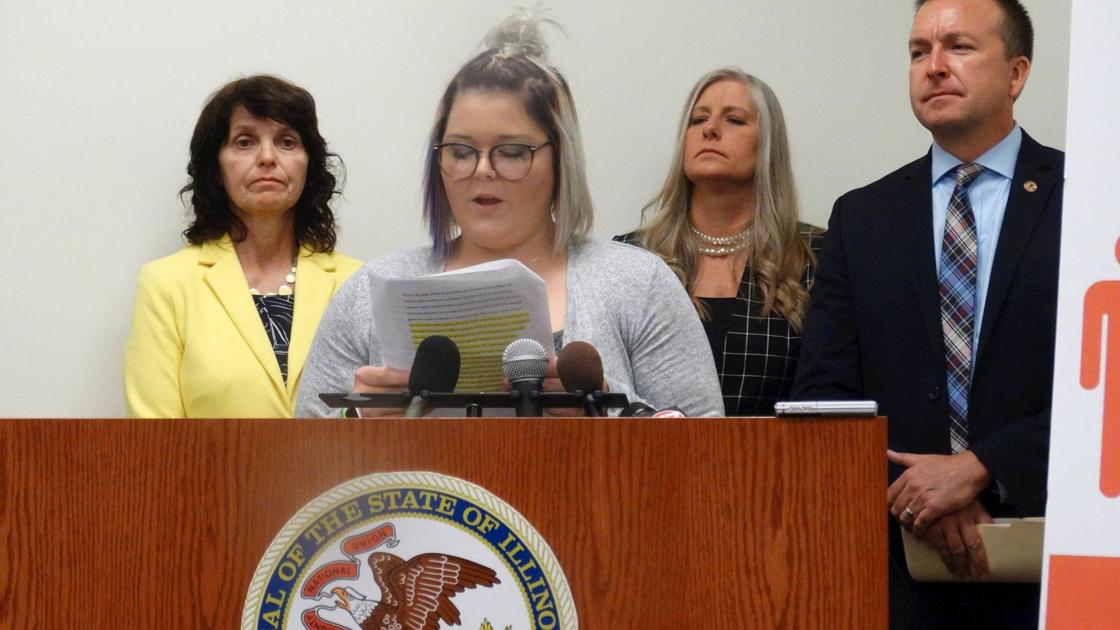
Blair spoke Tuesday at a news conference in Springfield surrounded by Democratic state lawmakers who are pushing for a bill that would bring down the out-of-pocket cost for insulin for many, but not all, diabetes patients in Illinois.

“The cost of insulin clearly is breaking families that we represent,” said state Sen. Andy Manar, D-Bunker Hill, one of the main sponsors of a bill that would cap the out-of-pocket cost of insulin at $100 for a 30-day supply.

“Ultimately what has to happen is our Congress and our president have to act on the runaway cost of pharmaceutical drugs,” Manar said. “Senate Bill 667 (Amendment 1), we hope, addresses an issue immediately in Illinois and serves as a stepping stone to a larger reform.”

Manar and fellow-Democrat Rep. Will Guzzardi, of Chicago, introduced the language of the bill in late May, and they hope to see it passed during the upcoming veto session that begins Oct. 28.

The bill comes on the heels of unsuccessful attempts during the regular spring session to impose even tighter controls on the cost of prescription drugs across the board in Illinois, proposals that met stiff opposition from the pharmaceutical industry.

The new bill, Manar said, focuses exclusively on insulin because of the scope of the problem and the number of people it affects.

You have run out of free stories. To continue reading, take advantage of our LOWEST offer yet!

Thanks for being a subscriber.

Sorry, your subscription does not include this content.

Please call 866.735.5912 to upgrade your subscription.

Citing figures from the Health Care Cost Institute, Manar said the average price of insulin in the United States nearly doubled between 2012 and 2016, rising to 25 cents per unit. For someone using an average amount of 60 units per day, that translates to an increase from $7.80 a day to $15 a day.

That’s a significantly higher cost than what people in other countries pay for the same drug. Manar noted that a single vial of one common form of insulin, Humalog, costs $20 in Japan and $31.60 in Canada. But in the United States, it costs $135.50, in large part because drug costs are subsidized in countries that have national health insurance systems.

“Insulin isn’t optional,” said Rep. Sue Scherer, D-Decatur. “It’s life-or-death for people, and it is so totally unfair that people are having to choose between insulin and food for themselves or their family.”

Blair said she is among many diabetes patients who routinely ration their insulin doses, taking less than the recommended dose, in order to stretch out their supply, something that often results in subsequent hospitalization.

“And not just the easy trip to the emergency room,” she said. “It usually ended up with a two- or three-day stay in the (intensive care unit).”

Leroy Jordan, 77, of Springfield, said he also struggles with the cost of insulin to treat his Type 1 diabetes. He said he was a grown adult when he was diagnosed with Type 1 diabetes, also known as juvenile, or insulin-dependent diabetes, a form of the disease that usually appears during childhood but which can develop later in life.

“This cost thing is just terrible,” he said. “When youngsters are born with diabetes, we that have it later in life kind of say, ‘Oh boy, I’m very fortunate.’ But it’s killing us too.”

Senate Bill 667 would not lower the cost of insulin for all patients in Illinois. It would apply only to those on publicly-funded health plans — primarily Medicare, Medicaid and the state employee health plan. Supporters of the bill were not immediately able to say how many people that would cover, but it would not cover people on private employer-based health plans because those are regulated under federal law.

In a statement, Tiffany Haverly, spokesperson for the Pharmaceutical Research and Manufacturers of America, a group that lobbies for the pharmaceutical industry, did not comment specifically on the bill. But she said the industry sympathizes with patients struggling to afford their medications and that support is available in the form of discounts and rebates to those who cannot afford their drugs.

“In addition to supporting commonsense solutions to lower Illinoisans’ out-of-pocket costs, PhRMA recently launched a new tool — the Medicine Assistance Tool, or MAT — to connect eligible patients with over 900 public and private assistance programs,” she said. “We encourage any patient struggling to afford their medicines to visit mat.org to see what resources might be available to them.”

Get Government & Politics updates in your inbox!

Stay up-to-date on the latest in local and national government and political topics with our newsletter.

15-Health,16-Econ,19-Legal,24-ILGA,25-Working,26-Delivered,AllPolGA

Region: Southern,Politics,City: Carbondale,Region: Carbondale

via thesouthern.com – RSS Results in news/local/govt-and-politics of type article https://ift.tt/2u5QikM

September 17, 2019 at 06:05PM

Blog at WordPress.com.

Up ↑