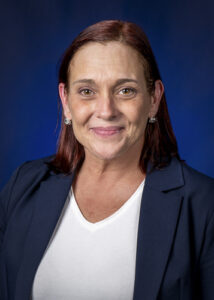
State Rep. Jehan Gordon-Booth hosted her annual Veterans Appreciation Breakfast to honor the 84th anniversary of the bombing of Pearl Harbor and to show appreciation for veterans and their families.
By MELISSA CROCKETT MESKE Managing Editor, Illinois Business Journal macmeske@ibjonline.com
State Representative Katie Stuart (D-Edwardsville) recently shared a response via social media regarding the Trump administration’s exclusion of certain post-secondary academic degrees from “professional” classification.
The Trump administration has proposed to narrow the federal definition of a “professional degree,” a move that would exclude programs and significantly restrict graduate students’ access to federal loans. The policy shift has drawn swift criticism from national organizations and raised financial concerns among students who rely heavily on federal aid to complete advanced degrees.
Under current rules, graduate students may borrow up to the full cost of attendance through federal loan programs.
The proposed new framework, unveiled on Nov. 6 by the U.S. Department of Education as part of what President Donald Trump has described as his “one big beautiful bill,” would impose strict annual and lifetime caps.
Graduate students in programs not classified as “professional” would be limited to $20,500 per year and a total of $100,000 in federal loans. By contrast, students enrolled in designated professional degree tracks would qualify for higher borrowing thresholds—up to $50,000 annually and a lifetime limit of $200,000.
The Education Department’s approved list includes programs such as medicine, law, dentistry, pharmacy, veterinary medicine, chiropractic, optometry, osteopathic medicine, podiatry and theology.
Among those notably absent from the list is nursing and teaching, sectors already grappling with workforce shortages.
Industry leaders warn that the revised classification could diminish the pipeline of candidates for these positions by making graduate education less financially accessible, with potential downstream implications for those sectors nationwide.
“Among the degrees Donald Trump’s administration now says aren’t professional are accountants, architects, audiologists, clinical psychologists, physical therapists, social workers and—perhaps most shocking—teachers and nurses.
“The vast majority of people don’t need me to explain why this is outrageous. Teachers, nurses, and the others so casually discounted and insulted by this travesty are some of the most professional—and most critical—workers in Illinois and the nation. Their everyday contributions to our communities save lives, enrich lives, preserve health and drive our economy in more ways than any of us can list.
“This disastrous policy will decrease opportunity, increase the already crushing level of student debt and discourage talented and capable individuals from pursuing careers in critically important and impactful fields–precisely when workers in those fields are in critically short supply in many parts of Illinois and the rest of the nation.
“That’s why I’m not done fighting to shield our communities from the fallout of these troubling times.”
Region: Metro East,Feeds,Business,Metro East,City: St. Louis, MO
Lawmakers across Illinois, including Aurora Democratic State Rep. Stephanie Kifowit, are working on drafting legislation for the spring legislative session coming up in January. Kifowit says she has received ideas from constituents on pressing topics like pension reform and property tax relief.
Kifowit says a proposal on reforming the tier two pension system, which has been in place since 2011, is needed to comply with federal guidelines. The General Assembly did not take action on pension reform during the fall veto session in October. Kifowit says without an effective pension plan in place, the state has started to see less retention and recruitment success in key areas like law enforcement and education.
"We also need to recognize that we, the state as a whole, is having a huge, huge retention and recruitment issue for key positions. Whether it’s teachers, whether it’s correctional officers, even state police, anybody that works for the state. We’re having a huge crisis getting good people, and part of the reason is because our neighboring states have a better pension plan than we do. And the private sector has a better retirement plan with Social Security and a 401k than we do."
Kifowit is also providing information to property tax relief task forces and committees to help bring effective property tax relief legislation to the General Assembly and help working families and others struggling with increases in recent years.
On the northeast corner of the 25-acre site sits the old Lincoln State School Cemetery, a burial ground for former residents of the nearby Lincoln Developmental Center (LDC), which closed in 2002. The disbanded facility was a residential state school for people with developmental disabilities.
The large gravesite contains the remains of approximately 2,130 LDC residents who passed while in state custody over the institution’s 125-year history.
A House resolution sponsored by state Rep. Katie Stuart, D-Edwardsville, asks the Illinois Department of Corrections (IDOC) to develop guidelines for visiting a cemetery located on the grounds of the center.
The IDOC inherited responsibility for the cemetery after former Gov. George Ryan ordered the LDC’s closure following decades of reported abuse, neglect, and preventable deaths. It’s a history that has followed the former LDC since its founding in 1877 as the Illinois Asylum for Feeble-Minded Children.
Sam Naftzger/NPR Illinois
The LDC campus sits behind a fence.
Dave Bakke, a historian, author, and former staff writer at The State Journal-Register, described the conditions of the former LDC in sobering detail.
“Conditions at the Lincoln State School were horrible; overcrowded and understaffed,” Bakke wrote in a 2016 article. “It was a community unto itself. The deaths of residents were not investigated, and their bodies were buried on the grounds.”
Bakke’s article blamed unsanitary conditions and understaffed management for several deaths related to the facility.
Investigations by the Illinois Department of Public Health, the Illinois Department of Human Services, and state police further detail the multitude of distressing cases surrounding the former LDC right up to its closure.
A covert investigation in 1993 led to the dismissal of 11 staff members and the conviction of another for the aggravated sexual assault of a resident.
In 1995, an LDC resident left unattended in the city of Lincoln was found drowned in a community pool.
In 1998, a resident restrained for over 30 minutes by staff died after choking on his own vomit.
In 2001, a resident who was denied access to a bathroom was forced to lick and mop up her urine with her clothing.
These incidents are among the several documented cases that led to the site’s decertification and closure, a significant economic blow to the city of Lincoln.
Estimates place the number of jobs the community lost between 428 and 700. For many, the consequences of the LDC’s closure remain a tender, unresolved issue.
The site of the Lincoln Developmental Center has sat unused since 2002. The buildings on the 114-acre campus exhibit decades of disuse and neglect.
“Nothing has happened with it,” said Lincoln resident Lynn Logan. “It’s unfortunate. I feel like they needed reform back then, but they closed everything and then left it to rot."
Future development of the site is planned. However, its ultimate future remains uncertain.
The Surplus to Success program, launched by the Illinois Department of Central Management Services, includes funds to demolish the site’s deteriorating buildings.
A total of $300 million will be allocated to the redevelopment of five state-owned properties, including the former Lincoln Developmental Center.
A new juvenile justice facility, known as the Monarch Youth Center, has already been constructed on a portion of the old LDC grounds. The facility is expected to bring nearly 100 jobs to the Lincoln area.
As for what will occupy the rest of the site, a multitude of ideas have been discussed. The construction of tiny homes for military veterans was an idea advanced by Lincoln Mayor Tracy Welch, who also serves on the Central Illinois Veterans Commission board.
A distribution center for the electric car manufacturer Rivian was also in discussion for the site, adding potential for jobs and innovation in the region. In recent years, the prison has expanded its grounds, complicating access to the cemetery.
Security concerns have made it difficult or outright impossible for families and researchers to gain access. Under the resolution, further development of the prison by the IDOC would require consideration of the cemetery and access to it.
“Families need access to the places where their loved ones have been laid to rest so they can honor and celebrate their lives,” Stuart said.
Stuart also explained IDOC’s lack of procedure for cemetery access has left families and friends of the interred to “wrangle” with on-site prison officials.
“It’s time for members of the public to have reasonable access to Lincoln Developmental Center Cemetery without undue hassle or runaround,” said Stuart.
Heather Megginson is the executive secretary at the Lincoln Correctional Center. She said inquiries about the cemetery are sparse.
“There are no inquiries on cemetery visits,” said Megginson. “It’s very rare. It’s very rare that anyone’s inquiring to come here.”
Megginson also suggested that over a period of five years, only two families have come to pay their respects.
Amanda Elliot, Illinois’ First Assistant Deputy Governor for Budget and Operations, raised skepticism over the resolution’s future
“It’s not going to happen because it’s dangerous,” said Elliot, citing the resolution’s potential risk to prison security.
As of July 1, the resolution has been re-referred to the House Rules Committee, which assigns legislation for hearings. So far, no further action has occurred
84th District Democratic State Rep. Stephanie Kifowit says it has been a slow time for the General Assembly following the fall veto session, but a piece of legislation that passed recently took effect with the help of Illinois Secretary of State Alexi Giannoulias. It was announced last week by Giannoulias that Apple users could scan their Illinois driver’s licenses or ID cards into their phone and use them as a digital form of identification.
Kifowit says the mobile ID program was born from House Bill 4592, which amended the Illinois Identification Card Act to allow optional access to a digital form of identification and was passed in May 2024. Governor J.B. Pritzker signed the bill into law in August 2024.
"The Illinois General Assembly had to pass the law to give him the authority to do that. So we did pass the law, and now it’s always good for me to see what comes to fruition when we pass laws to help people. And the mobile ID, as you might have reported on or not, is an acceptable form of identification, which can be used by folks to show that they are twenty one years of age or older, by just putting it in their Apple Wallet."
Kifowit says the new law will make it easier for people to properly identify themselves without reaching for their wallet or purse, especially as many people are moving their credit cards and documents like car insurance and passports to their digital wallets.
Kifowit also mentioned that Giannoulias’ office recently opened a new "one-stop shop" DMV facility at 1771 W. Diehl Road, which replaced the old facility on 75th Street that had been open for over 30 years. She says this new facility provides another location in the district for Illinois residents to service their various DMV needs, including getting their license or ID renewed, get new license plates, or taking a driver’s test.
Chip Markel, a Navy veteran and candidate for the Illinois 118th district, is organizing a food drive in each of the district’s five counties to benefit local organizations.
When: Thursday, Nov. 20; 10 a.m. until supplies run out
Where: Downtown Belleville YMCA; 200 S. Illinois St. in Belleville
Hosted by State Rep. Jay Hoffman and State Sen. Christopher Belt
State Rep. Jay Hoffman (D-Swansea)
An annual tradition returns Thursday, Nov. 20, 2025, as State Rep. Jay Hoffman (D-Swansea) and state Sen. Christopher Belt (D-Swansea) give out free turkeys, canned goods and other items to families to help them enjoy a full Thanksgiving dinner.
“This year we’re not just giving away turkeys; we’re providing a full Thanksgiving meal thanks to the generosity of residents who have donated goods,” Hoffman said. “This month has been an even more difficult time for those in need of food assistance, which is why I’m grateful for our community members who have stepped up once again to help their neighbors.”
State Senator Christopher Belt (D-Swansea)
Hoffman and Belt’s Thanksgiving Turkey Giveaway will take place from 10 a.m. until supplies run out on Thursday, Nov. 20 at the Downtown Belleville YMCA, located at 200 S. Illinois St. in Belleville.
Thanks to a generous donation from Meridian, Hoffman and Belt expect to offer 200 turkeys to families this year.
In addition to the main meal, families will receive cans or boxes of green beans, stuffing, gravy, cornbread and cranberry sauce.
The event will be held outside, and attendees will line up in the back parking lot along High St. Due to traffic congestion, the public is asked not to arrive before the start of the event.
Democratic State Re. Katie Stuart 112th District will face a primary opponent.
Veteran 112th District Democratic State Rep. Katie Stuart will once again have an opponent in next year’s general election.
What she won’t have is an opponent in the March 17 primary.
Halley Johnson, 20, of Granite City, filed nominating petitions Oct. 31 to be on the Democratic primary ballot. However, those petitions have been challenged by Sue Edwina Betts of Edwardsville. The Illinois State Board of Elections will conduct a hearing on Bett’s petition objections on Nov. 18.
Katie Stewart
It will likely be a brief hearing. According to the Illinois State Board of Elections Candidate Guide, anyone seeking to qualify for the 2026 primary ballot as an established party candidate must file signatures from “At least 500 but not more than 1,500 of the qualified primary electors of their party in their representative district.”
Johnson, who personally circulated all her nominating petition sheets, filed 26 sheets with the ISBE, which contained no more than 260 signatures.
Johnson said she “Brings a new standard of leadership to District 112 Granite City,” and is counting on voters “who have grown weary of waiting for relief on issues like property taxes and healthcare costs.”
Republican Jimmy Ford, an alderperson on the O’Fallon city council, filed 106 pages nominating petitions Oct. 27 to run in the GOP primary for the 112th House seat. Among those circulating petition sheets for Ford were 111th GOP State Rep. Amy Elik, R-111.
Ford owns several small businesses in the Metro East area, including a vehicle repossession business. He also volunteers as a First Officer/Diver for the O’Fallon Underwater Search and Recovery.
Ford will have a steep hill to trek. Stuart, of Edwardsville, took office in 2017 after defeating Republican incumbent Dwight D. Kay. She has held off several Republican challengers since then.
Screenshot
Stuart has more than $500,000 in her war chest, and Democratic House leadership has shown it’s ready and able to pour north of $1.5 million to defend her seat, funding numerous mailers, digital ads radio and television ads.
In the deep red southern third of Illinois, there are few blue House districts, particularly in the wake of Democrats losing the 114th House district in 2022, a seat the GOP successfully defended in 2024, despite being outspent by a 6-1 ratio.
But St. Clair County, and western Madison County still have Democratic strongholds, including Stuart, and Jay Hoffman in the 113th House. Democratic House and state party leadership have made it clear they will spend big to defend those seats.
Republican House leadership had high hopes in 2024 for Jay Keeven, a former chief of police with 35 years in law enforcement and a city administrator. Keeven survived an attempt by the Democrat-dominated legislature to block his candidacy and those of others through a rapidly passed law banning those who had not won a March primary contest from being on the general election ballot.
Keeven campaigned hard, but Stuart raised more than $1.8 million in her 2024 race, while Keeven managed just over $300,000, and lost by 4,240 votes and an 8.4 percent margin. That was the same margin and vote total Stuart won by in 2022.
Stuart was able to not only send back $202,100 to Democrats for the Illinois House two weeks prior to the election, she transferred $68,500 each to LaToya Greenwood’s campaign in the 114th district, and to Friends of Marti Deuter in the west suburban Chicago 45th District.
Stuart has the support of more than fellow Democrats. In 2024, the Illinois Farm Bureau’s political PAC, which generally favors Republicans, contributed $18,600 in in-kind spending on local radio and digital ads.
Region: Metro East,Feeds,Local
via Metro East Chronicle – Serving St. Clair County and Madison County, Illinois https://ift.tt/635ElS8