A Joliet state legislator has launched the Neurodiversity Legislative Advisory Committee, a monthly gathering intended to serve as a forum for neurodiverse individuals, their families and service providers.
State Rep. Natalie Manley, D-Joliet, said this follows her initiative in forming the Illinois Legislative Neurodiversity Caucus, which launched in April, according to a news release from her office.
The Neurodiversity Legislative Advisory Committee is the latest addition to Manley’s established series of such committees that specifically address social legislative issues. Other advisory committees include the Retirees LAC and the Grandparents Raising Grandchildren LAC.
Manley also restarted her Women’s LAC, which had strong participation before the COVID-19 pandemic, according to the release.
The inaugural NeuroLAC meeting, held on Joliet Junior College’s Romeoville campus, saw attendees share their experiences and proposals. Discussions spanned a wide array of pressing issues affecting the neurodiverse community, including access to services, early childhood education, and systemic gaps in care, employment and awareness, according to the release.
NeuroLAC is scheduled to meet monthly on the third Tuesday of each month on the JJC Romeoville campus, 1125 W. Romeo Road.
An RSVP is required to attend each meeting. To learn more, contact Manley’s office at 815-725-2741 or repmanley@gmail.com.
A long-sought rehabilitation of one of Peoria’s major South Side roadways will get underway in the next few weeks.
The $10 million overhaul of MacArthur Highway has been years in the making after State Rep. Jehan Gordon-Booth helped secure state funding for economic development along the corridor in 2023.
“As everyone is well aware, there are many roads in Peoria that need some attention, and this was one that’s been high on our list,” said City Engineer Andrea Klopfenstein. “The city applied for an Illinois Department of Commerce and Economic Opportunity [DCEO] grant and was awarded that funding, which is what is making this project possible.”
Klopfenstein said the road work and bicycle lane upgrades will assist the Community Development Department’s ongoing efforts to revitalize “a very important corridor” on the city’s South Side.
“We’re hoping that the road project spurs the redevelopment,” she said. “Between the infrastructure improvements and the projects that Community Development are doing, we’re hoping that brings in more economic opportunities for other businesses to come into the area.”
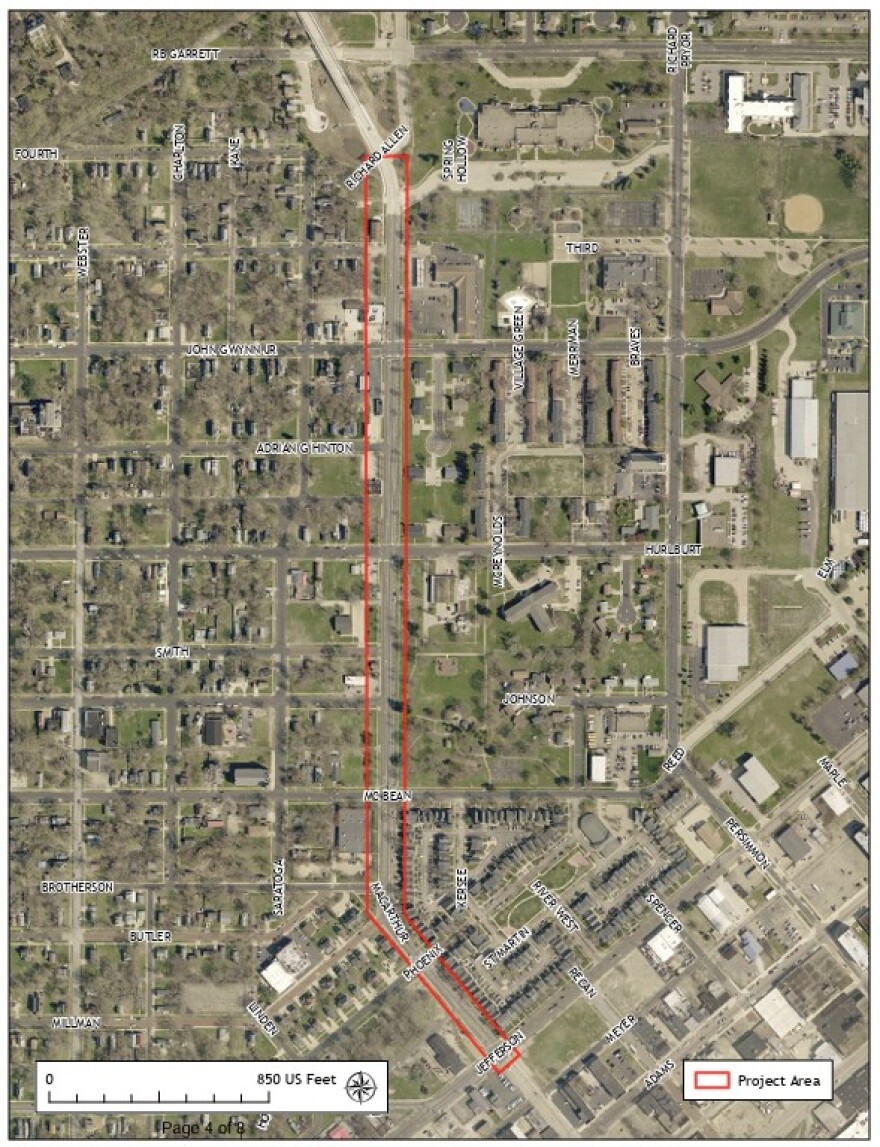
A map included in the agenda packet for the Peoria City Council meeting on July 8 shows the construction corridor for the MacArthur Highway Improvement Project.
A key component of the measure approved by the city council is an agreement with Illinois American Water that calls for the utility company to reimburse Peoria close to $1 million for covering the initial cost to replace the water main along MacArthur as part of the road construction.
“They pay for all their water main improvements, but it helps with coordination and scheduling so that the work gets done at the same time,” said Klopfenstein. “So instead of the public being disrupted for a water-only project before and then the road project, or a new road and then the water company coming in and tearing the new road up, it’s all done together so it’s much more effective and much more efficient for everyone.”
The realignment will create a three-lane roadway — one for travel in both directions, plus a center turn lane — on MacArthur from Fourth Street, just south of the MacArthur Bridge, to the Howett Street intersection. A multi-use path will be constructed on the east side of the highway, separated from vehicle traffic by a curb.
The pavement will be upgraded and new traffic signals will be installed at the Howett, McBean Street, and John H. Gwynne Avenue intersections. A raised intersection at Hurlburt Street will feature flashing beacons for pedestrians crossing the highway to get to Martin Luther King Jr. Park.
Klopfenstein said construction is expected to begin in mid-to-late August, with a majority of the work targeted for completion by late next year. But she cautions that road work timelines are always subject to change based on weather conditions and material availability.
“Prices and supplies are still in flux, with things that are going on at the federal level with tariffs and other things,” she said. “We are seeing that impact the prices of construction materials. and it’s not all construction materials equally across the board.
“On this project in particular, the water main items were expensive, the storm sewer items were expensive, and electrical items were even more expensive than what they’ve been in the past. So, we are definitely dealing with the very volatile market as far as pricing, and then also material availability is challenging.”
Klopfenstein said the city has been fortunate so far to not have weather delays impact other key infrastructure projects such as the one-way to two-way conversion of Adams and Jefferson, improvements at University Street and Pioneer Parkway, and the rehabilitation of Moss Avenue.
She said the hope is to keep the traffic disruptions from the MacArthur project to a minimum.
“There will be lane changes and people moving one way or another as we’re tearing parts of the roadway out and replacing them,” she said. “We will allow traffic to get through, so we won’t block all cross streets. But it will impact them as we go through those intersections and make those improvements.”
An Ottawa lawmaker continues to side with the Teamsters in their strike against Republic Services.
Democrat State Representative Amy “Murri” Briel visited with striking workers in Ottawa for the second time, saying she urges Republic Services to “negotiate fairly with Teamsters to protect over 8,000 waste collection workers and their families across the county.” Briel says striking Republic workers in the La Salle region make $10 less per hour than counterparts in surrounding areas. The lawmaker says the strike is well overdue with Republic Services workers being stretched thin and underpaid.
The national strike began more than two weeks ago. Since then, many towns have seen garbage pickup delayed and no recycling and yard waste taken at all by Republic Services.
Earlier this week, Republic Services sent out a statement saying that threatening actions by the Teamsters’ are hampering negotiation efforts.
ROMEOVILLE, Ill. – State Representative Natalie Manley (D-Joliet), in her ongoing commitment to inclusive governance, launched the inaugural Neurodiversity Legislative Advisory Committee (NeuroLAC).
The monthly gathering intends to serve as a dedicated forum for individuals who identify as neurodiverse, their families, and service providers to directly engage with legislators and share their invaluable insights for future policy development.
This follows Manley’s initiative forming the Illinois Legislators Neurodiversity Caucus, which launched in April. Members from the Illinois House of Representatives and Senate joined Manley — from both sides of the aisle — to advocate and responsibly legislate for Illinoisans who are neurodiverse.
NeuroLAC is the latest addition to Manley’s established series of Legislative Advisory Committees (LACs). Under Manley’s leadership, previous LACs have shaped legislation that specifically addresses issues that were identified during the committee meetings.
Manley’s previously existing LACs include the Retirees Legislative Advisory Committee (RLAC), and the Grandparents Raising Grandchildren Legislative Advisory Committee (GrandLAC). Additionally, Manley restarted her Women’s LAC, which had robust participation prior to Covid.
These committees underscore Rep. Manley’s dedication to ensuring a broad spectrum of voices inform the legislative process.
The inaugural NeuroLAC meeting, held at the Joliet Junior College Romeoville Campus saw many participants. The attendees openly shared their experiences and proposals. Distinguished guests included State Representative Dagmara Avelar (D-Romeoville) and State Senator Meg Loughran Cappel (D-Shorewood), highlighting the cross-chamber commitment to this critical initiative.
Discussions spanned a wide array of pressing issues affecting the neurodiverse community including, access to service, early childhood education, systemic gaps in care, employment and awareness.
“The Neurodiversity Legislative Advisory Committee provides a direct line for those living in a neurodiverse community to share their lived experiences and legislative ideas,” Manley said. “Their voices are powerful and essential to crafting effective, compassionate legislation. I am deeply grateful to everyone who attended and shared their insights. Their contributions are invaluable as we work to build a more inclusive Illinois.”
This direct pipeline from community input to legislative action ensures that policies are grounded in the real-world needs and experiences of the neurodiverse community.
NeuroLAC is scheduled to meet monthly on the third Tuesday of each month at the JJC Romeoville Campus, an RSVP is required to attend each meeting. To learn more about participation, please call/text Rep. Manley’s District Office at (815) 725-2741 or email at repmanley@gmail.com.
A state freshman lawmaker is proposing new bills targeting action against U.S. Immigration and Customs Enforcement agents, but she’s not fully optimistic they’ll change anything.
State Rep. Amy “Murri” Briel, D-Ottawa, told an audience at Northern Illinois University in DeKalb this month that her office says they’ve received word that federal immigration action appears to be spreading across the state. Briel represents the 76th House District, which includes portions of DeKalb and La Salle counties.
“ICE activity has been reported,” Briel said July 11. “We’re beginning to see upticks in all parts of the state. We didn’t see very many [confirmed reports], but you’re right, there have been many instances [of unconfirmed reports]. Those appear to be specifically targeted instances at particular individuals. But if the budget bill that passed the federal government has anything to say about it, we will be anticipating a much bigger presence here.”
Briel said she believes the state’s priorities are in order, but wants changes at the federal level.
In Springfield, Briel and other lawmakers are proposing three bills, which she said are in preliminary stages, meant to address ICE activity in Illinois.
“We have one person who’s working on a mask legislation, but I don’t believe that that’s an avenue that will go anywhere,” Briel said. “But at the state level, we’re doing everything we can to ensure that those who are enforcing the laws, the federal laws are doing so according to the Constitution and according to the laws of the state of Illinois.”
State Rep. Amy “Murri” Briel, D-Ottawa, talks Friday, July 11, 2025, about some of the obstacles they have faced in this session during her town hall at at Northern Illinois University’s Holmes Student Center in DeKalb. Briel will be hosting town halls later this year in Oglesby and Utica. (Mark Busch)
Recently, DeKalb Mayor Cohen Barnes said he’s fielded calls and inquiries from residents about alleged ICE visits in DeKalb because of the immigration policies pushed by President Donald Trump and his administration.
“There’s been a lot of concern with what’s happening at the national level,” Barnes said on June 19. “And I’ve had multiple one-on-one conversations with people about it, clarifying the city of DeKalb’s stance that ultimately we’re following state law. Our DeKalb Police Department won’t interact with ICE agents. And really at the core level for us, we want to be able to have a trusting relationship with everyone that lives in the city of DeKalb.”
A DeKalb-based service group, DeKalb Area Rapid Response Team, over the past few weeks have posted on social media reporting they’d received multiple videos on several different occasions. The group, formerly known as Welcoming Western Counties, alleged that the videos showed ICE agents approaching people in DeKalb. The organization, which includes people from faith communities and area service agencies, reportedly has what it calls a “Rapid Response Team” ready to aid people who may be approached by federal immigration agents.
The team’s staff did not respond to request for comment by press time.
Shaw Local News Network has been unable to confirm any ICE-related arrests or activity in DeKalb County.
State Rep. Amy “Murri” Briel, D-Ottawa, talks Friday, July 11, 2025, about some of the difficulties facing Illinois residents during her town hall at at Northern Illinois University’s Holmes Student Center in DeKalb. Briel will be hosting town halls later this year in Oglesby and Utica. (Mark Busch)
When reached by Shaw Local on June 17, DeKalb Police Chief David Byrd said he could not confirm if ICE agents were in town or if any arrests had occurred. When reached July 11, DeKalb County Sheriff’s Chief Deputy Jim Burgh said the Sheriff’s Office is not aware of any ICE arrests or activity in the area. He said he also is not aware of any immigration agents entering the DeKalb County Courthouse in Sycamore.
But that hasn’t stopped rumors and fear from surging, in DeKalb and beyond.
About a month ago, amid swirling social media posts, Rockford Mayor Tom McNamara confirmed the U.S. Department of Homeland Security was in the city, but said officials “cannot confirm whether it was specifically ICE,” noting that ICE operates under the DHS, McNamara said in a video posted to the city’s Facebook page June 12.
In a statement to Shaw Local in response to inquiries on whether federal immigration enforcement agents had been in DeKalb, a spokesperson for the DHS did not address DeKalb questions specifically.
“U.S. Immigration and Customs Enforcement officers and agents are on the streets every day, prioritizing public safety by locating, arresting, and removing criminal alien offenders and immigration violators from our neighborhoods,” according to the statement. “All aliens in violation of U.S. immigration law may be subject to arrest, detention and if found removable by final order, removed from the U.S.”
When asked directly if immigration agents were in DeKalb, the FBI’s Chicago field office also did not confirm.
“For the past several months the FBI, along with other Department of Justice law enforcement partners, have been assisting the Department of Homeland Security in targeted enforcement operations, at the direction of the Attorney General,”an FBI Chicago field office spokesperson said.
Barnes – who ran as a Democrat in 2024 for the seat Briel now holds – criticized the Republican president for targeting Democrat-led cities and communities with heavy immigrant populations.
“For the president of the United States to single out communities based off of their policies on immigration, I think, is a political maneuver and not in the best interests of the citizens of the U.S.,” Barnes said. “We should treat every city and every state equally when it comes to the enforcement of our state and federal laws. The political games need to stop.”
Immigration raids have been heavily prioritized months into Trump’s second term.
Massive “No Kings” protests opposing Trump-era policies such as immigration took place last month, including in Chicago, DeKalb and across northern Illinois. Another protest, named “Good Trouble Lives On” by organizers, is planned at noon Saturday at Hopkins Park in DeKalb to honor the birthday of the late U.S. Rep. John Lewis.
PEORIA, Ill. – With a new school year in Peoria just a couple weeks away, the community is coming together to help get kids ready for the classroom.
The 5th annual One Peoria event, sponsored by State Representative Jehan Gordon-Booth and State Senator Dave Koehler, was held Tuesday afternoon at Glen Oak Park.
Families were able to receive backpacks, school supplies, immunizations for their kids, and more at no cost to them. Clear backpacks were available for those kids who needed them, after Peoria Public Schools passed a measure last month to require them for the middle and high schools.
Gordon-Booth says she herself remembers how expensive it was to get school supplies for her own kids.
“Obviously, my husband and I, we can afford it, but it just made me think about all the people in this community who do not have the ability to afford to really get their kids off to a great start first day of school,” Gordon-Booth said.
Gordon-Booth says the event also gives kids a chance to have a fun day out and relax before the start of a new school year. Activities at One Peoria included bounce houses, and snow cones.
Kids were also able to sign up for after-school activities at the event. Organizations such as area non-profits and Peoria first responders were present and mingled with the children in attendance.
State Rep. Murri Briel and labor professor Robert Bruno will be the main speakers at the La Salle Democrats’ annual picnic on Saturday, July 19.
The public is invited to purchase tickets and attend the BBQ from noon-4 p.m. Saturday, July 19 at Buffalo Rock State Park.
Briel represents the 76th district and was elected in November 2024.
Bruno is director of the Labor Education Program and a professor of labor and employment, as well as the director of the Project for Middle Class Renewal in the School of Labor and Employment Relations at the University of Illinois at Urbana-Champaign.
The event includes burgers, hot dogs, a cake walk, face painting, 50/50 drawing, kids’ games and raffle baskets.
Proceeds to benefit Democratic candidates in La Salle County.
Tickets cost $20 per person and $40 per family.
Become a gold-level sponsor by donating $1,000 (includes up to 40 tickets); silver-level sponsor by donating $500 (includes up to 20 tickets); or bronze-level sponsor by donating $250 (includes up to 10 tickets);
by Randy Pierce • Illinois State Representative from the 112th District Katie Stuart is making herself available to meet with constituents on July 17, from 4:30 p.m. to 6 p.m. at 2105 Vandalia Street, Unit 16, in Collinsville. Anyone with questions or concerns they wish to address to Stuart may do so at this time.
The building where this is taking place also serves as a location for the New Hope Christian Center, Traffic Law Center and BioMetric Impressions.
The 112th district represented by Stuart, who was elected to the state legislative office in 2016, includes all or parts of the cities of Caseyville, Collinsville, Edwardsville, Fairmont City, Maryville, Glen Carbon, Bethalto, Wood River and other communities further to the south.
Stuart has sponsored over 50 bills since taking office with the more recent legislation including those focusing on women’s issues, higher education, elder abuse and support for first responders.
An Edwardsville resident, she taught math at Southern Illinois University Edwardsville prior to taking office in the Illinois House of Representatives with an election victory over incumbent Dwight Kay.
ROCKFORD, Ill. (WREX) — State Representative Maurice West gathered local leaders and organizations to announce local funding from this year’s state budget in a press conference Tuesday.
Despite the budget being what West described as tight, and other items having to be cut, West said he fought for several local organizations to receive funding. These included places like the Family Peace Center and Northern Illinois Land Bank.
"The work that they’re doing, it goes longer and serves longer than what a fiscal year of a budget. The work that they’re doing has a lifelong impact on a lot of community members so how can we make sure that we don’t balance the budget on the backs of people who need it the most?" West said.
Another recipient was the Rockford Park District, who received a half a million dollars for park and pool upgrades, something they are grateful he put the effort into.
"Representative West knows that the Rockford Park District plays a vital role in our region. We help our region thrive. We’re an economic catalyst through all the facilities and events that the park district does. We play a significant role in the health and wellness of families, and we put kids on a pathway to success," Jay Sandine, the Executive Director of the park district said.
The funding also went to other local organizations, including the Rockford Area Habitat for Humanity and the Northwest Community Center.
For urgent breaking news and severe weather updates – click here to download the 13 WREX News App and the 13 WREX Weather Authority App.
:quality(70)/cloudfront-us-east-1.images.arcpublishing.com/shawmedia/TECZ5PGNMNHS7NB2BYAF44VDSI.JPG)
:quality(70)/cloudfront-us-east-1.images.arcpublishing.com/shawmedia/DYZVGECW7NA4JHEWUHLHJSBCXE.JPG)

