A new law led by state Rep. Amy “Murri” Briel, D-Ottawa, will make it easier for Illinois farmers to use large farm equipment during harvest by extending the time temporary workers can use commercial driver’s licenses (CDLs) for farm work.
“It’s very common for farms across the state to employ temporary help during planting and harvesting season, and we want to ensure these workers are able to operate equipment critical to the farm’s success,” Briel said in a news release. “By extending the license availability to operate farm equipment another 30 days, we won’t be taking away these crucial tools halfway through their harvesting seasons.”
Previous laws didn’t allow temporary workers to use their CDL licenses to operate large farm equipment, like combines or irrigation machines, through the end of harvest season.
Senate Bill 849 lets temporary farm workers use their CDL licenses for up to 210 days in a year, instead of 180, so they can operate large farm equipment through a full planting and harvest season.
“I’m pleased to work on legislation that will directly uplift my community of farm families who have been integral to sustaining Illinois’ food supply for generations,” Briel said. “Expanding this license availability is essential to maintain the efficiency and prosperity of Illinois farms.”
The bill was signed into law on Friday, Aug. 15 and will go into effect January 1 of next year.
State Rep. Katie Stuart represents the 112th District that includes Edwardsville and Glen Carbon. She can be reached at repkatiestuart@gmail.com. Aug …
State Rep. Amy Murri Briel, D-Ottawa, spoke Monday night at Illinois Valley Community College in Oglesby to update residents on her work in Springfield, focusing on healthcare, roads and how communities can work together to make a difference.
At the second of three sessions on her summer town hall tour, Briel opened by explaining her budget focus in Springfield has been “making sure our investments reflect our communities’ needs,” highlighting recent funding boosts for local schools, job training programs and various road projects in La Salle County.
“We’re seeing the results of smart, steady investments so far,” Briel said. “It’s not flashy, but it’s making a difference in classrooms, in job training programs and in how safe and reliable our roads are.”
A big topic of conversation in the Illinois Valley – Briel made sure to talk about healthcare, emphasizing efforts to support hospitals and improve access to care in local rural communities.
“We increased the Medicaid reimbursement rates to help safety-net hospitals stay open, including many rural hospitals that are essential to their communities,” Briel said. “We still have a long way to go – hospital closures like St. Margaret’s in Spring Valley show us how fragile our system can be.”
She also highlighted expanding Medicaid coverage for women’s health services.
“We now cover doulas, postpartum care and other important services that weren’t reimbursed before,” she said. “Maternal health is a big concern, especially in areas where access is limited.”
Looking at the bigger picture, Briel criticized the shift in rural healthcare from patient care to consumer profit.
“We’re no longer just patients; we’re treated like consumers. When that happens, healthcare becomes about profits instead of people. It’s time to hold the medical industrial complex accountable and fight for care that puts patients first.”
“When people come together and demand better, we see change. We deserve care that respects us, not just treats us like a commodity.”
Marlene Moshage, a member of the Illinois Valley Community College Board of Trustees and a new volunteer with the Voluntary Action Center, thanked State Rep. Amy Murri Briel for highlighting the importance of programs like Meals on Wheels during Monday’s town hall at IVCC. (Bill Freskos)
On infrastructure, Briel broke down how the state funds its roads and bridges, focusing on the gas tax.
“The gas tax is a key source of funding for maintaining our roads, bridges, and local transportation,” she said. “It’s collected at both the state and federal levels and then divided among different funds – some goes to state highways, some to counties and municipalities.”
“That’s why when you drive from one town to another, you might see different gas prices. Local governments can add their own taxes on top of the state and federal gas tax to fund their road projects. So, gas tax dollars directly impact the quality of the roads you drive on every day.”
She connected that to the bigger picture of infrastructure challenges and rising utility costs locally.
“We’re facing an energy crisis with rates going up and utilities struggling to keep up with needed infrastructure improvements,” she said. “That’s why we’re working toward an energy omnibus bill this fall to provide relief and fix the system. If it doesn’t pass this session, we’ll bring it back next spring.”
As prices rise, she encouraged residents to take advantage of utility assistance programs.
“There are programs through NICOR and ComEd that can help with monthly bills or offer incentives. Don’t hesitate to reach out if you’re struggling – help is available,” she said.
Throughout the session, Briel pointed to the challenges posed by recent federal funding cuts and corporate influence, but expressed optimism that advocacy and working together as a community can lead to real change.
Looking ahead, Briel’s third and final town hall session will be held at 6 p.m. on Sept. 9 at the International Union of Operating Engineers Hall, 740 E. Route 6, Utica.
If you have questions or concerns you’d like to share with State Representative Amy “Murri” Briel, a town hall meeting would be the perfect opportunity to do just that.
The Democrat from Ottawa is hosting three town halls later this summer in DeKalb, Utica, and Oglesby. The first town hall took place last monthat Northern Illinois University in DeKalb. Briel will be available Mondayat Illinois Valley Community College in Oglesby. In September, Briel will host a town hall on the 9that the International Union Operators Engineers Hall (old Celebrations 150) along Route 6 in Utica. Each town hall starts at 6.
Briel hopes the town halls enable her to hear your thoughts on “hyperlocal” issues. You are asked to RSVP if planning to attend any of the Representative Briel town halls by clicking here
(WIFR) – Democratic State Representative Maurice West will run for re-election as state representative of the 67th district.
West is currently serving his fourth term representing the 67th district, which includes parts of Rockford, Loves Park, New Milford and Cherry Valley.
“Serving this community is the honor of a lifetime, and we have so much more work to do together,”said State Rep. Maurice West. “We’ve brought record state investments to Northern Illinois, but there are still too many who struggle to afford the basics in our community – housing, childcare, healthcare, groceries, and more. My focus is to continue to fight for a better, stronger Rockford region, one where everyone has the ability to thrive.”
West also serves as Assistant Majority Leader, chair of the bipartisan Legislative Ethics Commission and chair of the Elections and Ethics Committee in the Illinois House of Representatives.
“Since I was first elected, I’ve worked collaboratively with anyone who is ready to invest in our region, grow good paying jobs, and make our community more vibrant,” said West.“Especially with the chaos coming out of Washington, D.C. right now, we need local leaders who are ready to step up and do what is right for our people. I would be honored to be reelected to continue this fight for this place I love so much.”
Illinois’ general primary is set for March 17, 2026, with the midterm election scheduled for Nov. 3, 2026.
<p>In another transparent attempt to distract from his failed presidency, Donald <a class="Link" href="https://ift.tt/57IhJPT" target="_blank" >Trump took to Truth Social</a> to rant about a successful progressive criminal justice reform. This time, Trump is blaming individual crimes in New York and Illinois on reforms reducing the role of money in pretrial jailing. Clearly, he hopes that we won’t notice that he is tanking the economy, covering up his relationship with Jeffrey Epstein and slashing funding for Medicare, Medicaid, public education, violence prevention programs and essentially any critical service for anyone who isn’t a billionaire.</p><p>Illinois is making progress. <a class="Link" href="https://ift.tt/hyLdcf8" target="_blank" >Crime is down</a>, and our state leaders are funding <a class="Link" href="https://www.youtube.com/watch?v=h0hSyBEdPYE" target="_blank" >programs that work</a>. Our state has invested millions of dollars in violence prevention programs and bolstered the social safety net. These policy decisions stand in stark contrast to Trump’s reckless moves to gut funding for domestic violence victims, system-involved children, people suffering from addiction and those considering suicide. Rather than lashing out, the president should sit down and let adults get back to work improving the lives of marginalized people across the U.S.</p><p>As is his modus operandi, the president lied about how our system of detention works under the Pretrial Fairness Act. Like Illinois Republicans who are more interested in spreading fear than debating facts, Trump suggested the Pretrial Fairness Act lets dangerous people accused of crimes flood the streets. As everyone who covers the pretrial system with integrity knows, ending cash bail doesn’t mean dangerous people are roaming the streets. It means that a judge decides whether a person should be released from jail pending trial based on risk and not wealth.</p><p>In fact, Illinois courts are now spending more time on each case where someone accused of a violent crime may be released while he or she awaits trial. <a class="Link" href="https://ift.tt/gIB5o6a" target="_blank" >Research from Loyola University</a> Chicago shows that across the state, these hearings are now lasting between 10 to 30 minutes, sometimes going as long as an hour. Under the old system, bond hearings took a mere few minutes, sometimes even seconds. Illinois judges now have more information about each case and are spending more time evaluating pretrial decisions than almost any jurisdiction in the country.</p><div class="RichTextSidebarModule Enhancement" data-module data-align-floatRight><a class="AnchorLink" id="module-710000" name="module-710000"></a>
<div class="RichTextSidebarModule-title">Commentary bug</div>
<div class="RichTextModule-items RichTextBody"><h2>Commentary</h2></div>
</div><p>Guardrails within the law ensure that courts are spending time focusing on the most serious cases. Under the old cash bond system, courts, on occasion, were spending as much time evaluating pretrial release on minor cases as they were when people were charged with murder. The Pretrial Fairness Act is ensuring that courts focus time on cases that could potentially impact public safety. </p><p>If judges believe someone is a danger to the community, they can detain that person in jail pending trial. Under the cash bail system, that person — if he or she had access to the right amount of money — would have been able to purchase his or her freedom. A system based on risk and not wealth makes sense, and it is unsurprising that we have not seen <a class="Link" href="https://ift.tt/fP8QLXY" target="_blank" >an increase in crime</a> since the implementation of the Pretrial Fairness Act. It is equally unsurprising that the president prefers a system that benefits the wealthy over one tied to public safety.</p><p>There are numerous contributors to crime, but perhaps the president’s cruel policies will play the largest role in destabilizing our communities, which can inevitably lead to increases in crime. In just six months, the Trump administration has <a class="Link" href="https://ift.tt/Apg6Q8P" target="_blank" >gutted substance use prevention and mental health treatment programs</a>. He has <a class="Link" href="https://ift.tt/UNWsrSd" target="_blank" >cut over $800 million</a> in grants that supports violence intervention programs and survivor support programming. He canceled a grant <a class="Link" href="https://ift.tt/NSUwvaX" target="_blank" >to prevent domestic violence</a>. These are not the actions of a man serious about protecting the public. And when Trump’s policies result in more people breaking the law, he will use these incidents to justify doubling down on the failed policies of mass incarceration as other leaders have done in the past.</p><p>Decades of research on policies of austerity and mass incarceration show they don’t stop crime and have a detrimental effect on larger society. With entire generations of Black and Brown men behind bars, their families’ lives on the outside are also destroyed. Many communities are still feeling the long-term devastation from the policy choices of the past. If we naively choose to repeat those mistakes, we will only further entrench the inequality and violence these communities are already wrestling with.</p><p>For months leading up to the implementation of the Pretrial Fairness Act, Illinoisans were warned about "the end of days" and "the purge." But two years later, we can see that crime did not go up after the Pretrial Fairness Act. In fact, <a class="Link" href="https://ift.tt/IfEW3L9" target="_blank" >certain serious crimes have plummeted</a>. The president’s attack on this law, like his budget cuts, proves once again that he isn’t interested in keeping our communities safe. We are proud to live in a state that operates in evidence and reality instead of fear. If only we could say the same about our federal government.</p><p><i>State Rep. Gregg Johnson represents the 72nd District in the Illinois House and state Rep. Will Guzzardi represents the 39th District in the Illinois House.</i></p><div class="RichTextSidebarModule Enhancement" data-module data-align-center><a class="AnchorLink" id="module-240000" name="module-240000"></a>
<div class="RichTextModule-items RichTextBody">Send letters to <a class="Link" href="mailto:letters@suntimes.com" target="_blank" >letters@suntimes.com</a>. More about <a class="Link" href="https://ift.tt/SDo1Ali" >how to submit here</a>.<br><br>Get Opinions content delivered to your inbox. Sign up for our <a class="Link" href="https://ift.tt/InFceti" target="_blank" >weekly newsletter here</a>.<br></div>
</div><p></p>
A Joliet state legislator has launched the Neurodiversity Legislative Advisory Committee, a monthly gathering intended to serve as a forum for neurodiverse individuals, their families and service providers.
State Rep. Natalie Manley, D-Joliet, said this follows her initiative in forming the Illinois Legislative Neurodiversity Caucus, which launched in April, according to a news release from her office.
The Neurodiversity Legislative Advisory Committee is the latest addition to Manley’s established series of such committees that specifically address social legislative issues. Other advisory committees include the Retirees LAC and the Grandparents Raising Grandchildren LAC.
Manley also restarted her Women’s LAC, which had strong participation before the COVID-19 pandemic, according to the release.
The inaugural NeuroLAC meeting, held on Joliet Junior College’s Romeoville campus, saw attendees share their experiences and proposals. Discussions spanned a wide array of pressing issues affecting the neurodiverse community, including access to services, early childhood education, and systemic gaps in care, employment and awareness, according to the release.
NeuroLAC is scheduled to meet monthly on the third Tuesday of each month on the JJC Romeoville campus, 1125 W. Romeo Road.
An RSVP is required to attend each meeting. To learn more, contact Manley’s office at 815-725-2741 or repmanley@gmail.com.
A long-sought rehabilitation of one of Peoria’s major South Side roadways will get underway in the next few weeks.
The $10 million overhaul of MacArthur Highway has been years in the making after State Rep. Jehan Gordon-Booth helped secure state funding for economic development along the corridor in 2023.
“As everyone is well aware, there are many roads in Peoria that need some attention, and this was one that’s been high on our list,” said City Engineer Andrea Klopfenstein. “The city applied for an Illinois Department of Commerce and Economic Opportunity [DCEO] grant and was awarded that funding, which is what is making this project possible.”
Klopfenstein said the road work and bicycle lane upgrades will assist the Community Development Department’s ongoing efforts to revitalize “a very important corridor” on the city’s South Side.
“We’re hoping that the road project spurs the redevelopment,” she said. “Between the infrastructure improvements and the projects that Community Development are doing, we’re hoping that brings in more economic opportunities for other businesses to come into the area.”
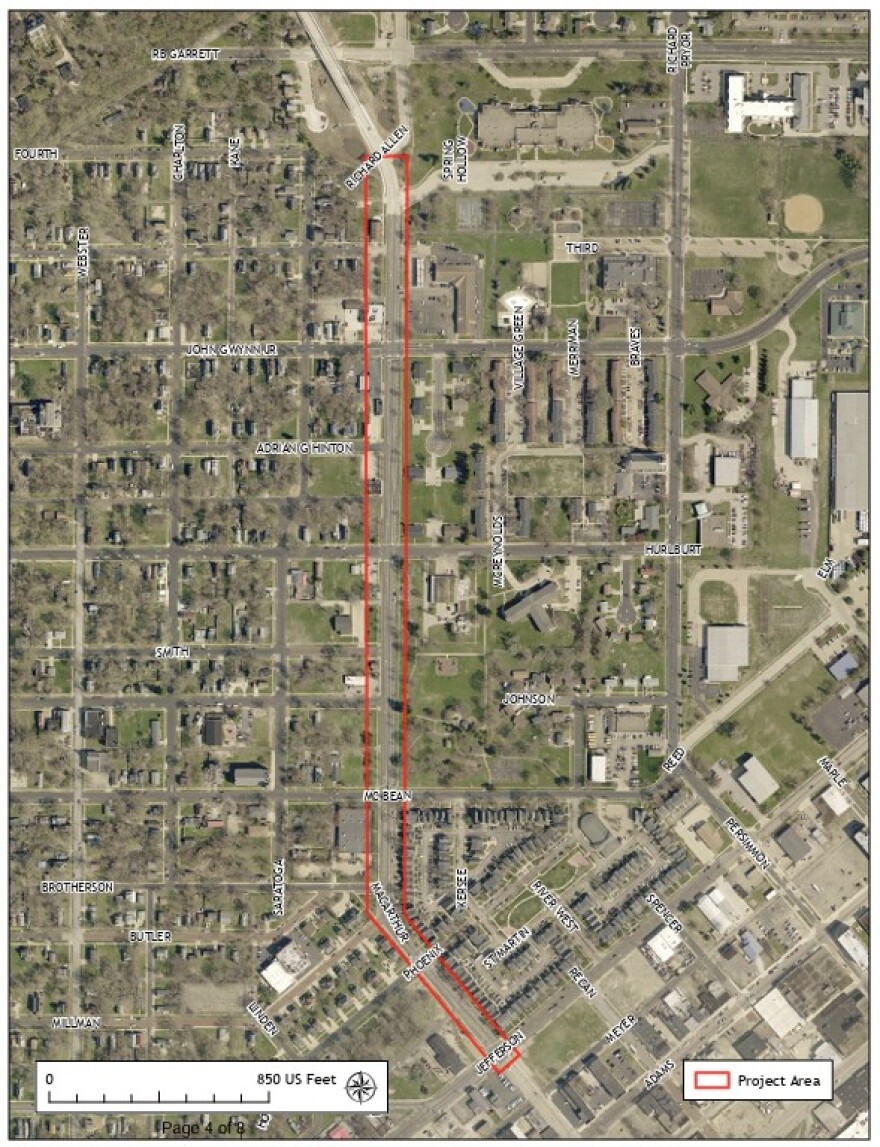
A map included in the agenda packet for the Peoria City Council meeting on July 8 shows the construction corridor for the MacArthur Highway Improvement Project.
A key component of the measure approved by the city council is an agreement with Illinois American Water that calls for the utility company to reimburse Peoria close to $1 million for covering the initial cost to replace the water main along MacArthur as part of the road construction.
“They pay for all their water main improvements, but it helps with coordination and scheduling so that the work gets done at the same time,” said Klopfenstein. “So instead of the public being disrupted for a water-only project before and then the road project, or a new road and then the water company coming in and tearing the new road up, it’s all done together so it’s much more effective and much more efficient for everyone.”
The realignment will create a three-lane roadway — one for travel in both directions, plus a center turn lane — on MacArthur from Fourth Street, just south of the MacArthur Bridge, to the Howett Street intersection. A multi-use path will be constructed on the east side of the highway, separated from vehicle traffic by a curb.
The pavement will be upgraded and new traffic signals will be installed at the Howett, McBean Street, and John H. Gwynne Avenue intersections. A raised intersection at Hurlburt Street will feature flashing beacons for pedestrians crossing the highway to get to Martin Luther King Jr. Park.
Klopfenstein said construction is expected to begin in mid-to-late August, with a majority of the work targeted for completion by late next year. But she cautions that road work timelines are always subject to change based on weather conditions and material availability.
“Prices and supplies are still in flux, with things that are going on at the federal level with tariffs and other things,” she said. “We are seeing that impact the prices of construction materials. and it’s not all construction materials equally across the board.
“On this project in particular, the water main items were expensive, the storm sewer items were expensive, and electrical items were even more expensive than what they’ve been in the past. So, we are definitely dealing with the very volatile market as far as pricing, and then also material availability is challenging.”
Klopfenstein said the city has been fortunate so far to not have weather delays impact other key infrastructure projects such as the one-way to two-way conversion of Adams and Jefferson, improvements at University Street and Pioneer Parkway, and the rehabilitation of Moss Avenue.
She said the hope is to keep the traffic disruptions from the MacArthur project to a minimum.
“There will be lane changes and people moving one way or another as we’re tearing parts of the roadway out and replacing them,” she said. “We will allow traffic to get through, so we won’t block all cross streets. But it will impact them as we go through those intersections and make those improvements.”
An Ottawa lawmaker continues to side with the Teamsters in their strike against Republic Services.
Democrat State Representative Amy “Murri” Briel visited with striking workers in Ottawa for the second time, saying she urges Republic Services to “negotiate fairly with Teamsters to protect over 8,000 waste collection workers and their families across the county.” Briel says striking Republic workers in the La Salle region make $10 less per hour than counterparts in surrounding areas. The lawmaker says the strike is well overdue with Republic Services workers being stretched thin and underpaid.
The national strike began more than two weeks ago. Since then, many towns have seen garbage pickup delayed and no recycling and yard waste taken at all by Republic Services.
Earlier this week, Republic Services sent out a statement saying that threatening actions by the Teamsters’ are hampering negotiation efforts.
:quality(70)/cloudfront-us-east-1.images.arcpublishing.com/shawmedia/YNC6APBUIBDAHLABUEQG3MONSE.jpg)

 Working for Illinois Caucus