Search

Working for Illinois Caucus

House Downstate Democrats work for the good people of Illinois

Category

Uncategorized

Avelar sponsors Bill to exempt tax on food, medical equipment

https://ift.tt/1BsjITW

Rep. Dagmara "Dee" Avelar

As a part of her efforts to provide relief for families during the pandemic, state Rep. Dagmara “Dee” Avelar, D-Bolingbrook, is sponsoring a bill that would lower taxes on certain food, drugs, and medical appliances.

“The ongoing COVID-19 pandemic continues to provide economic challenges,” said Avelar. “By exempting certain everyday products from a tax, this bill will put money back into the pockets of families across Illinois.”

House Bill 4819 exempts many medical materials, such as prescription and nonprescription drugs, medical devices used for cancer treatment, insulin, and blood sugar testing materials from a 1 percent tax. Most food that is not prepared for immediate consumption will also be included under the exemption. The bill is modeled after a provision of the FY 2023 budget proposal by Gov. JB Pritzker.

“No one should have to go without the food, medicine and medical equipment they need,” said Avelar. “This bill is one part of my ongoing fight to provide relief for families and lower the cost of healthcare materials. I’m proud to stand with the governor to build a stronger Illinois.”

via The Times Weekly

February 16, 2022 at 11:15PM

Illinois lawmakers examine building codes, emergency alert protocols in wake of deadly Edwardsville tornado

https://ift.tt/PAjqCyE

SPRINGFIELD, Ill. (NEXSTAR) — A panel of House lawmakers reviewed building code protocols and heard testimony from emergency management experts at a warehouse standards hearing on Monday in an effort to improve workplace safety during natural disasters.

The House Labor and Commerce Committee held the hearing in response to the EF-3 tornado that tore the roof from the Edwardsville Amazon fulfillment center last December. The building collapsed, killing six workers inside and seriously injuring another.

Rep. Jay Hoffman (D-Swansea) and Rep. Katie Stuart (D-Edwardsville) both represent districts ravaged by the tornado.

“Our obligation as elected officials to look at whether or not there were things that could have been done with regard to the building code, with regard to the safety of workers,” Hoffman said. 

"We can’t stop tornadoes," Stuart said, "but hopefully we can do what we can to stop loss of life and protect people."

The National Institute of Standards and Technology says more tornado deaths happen indoors than outside, and often that’s because people don’t take the proper precautions.

“Tornadoes cause more fatalities in the US than hurricanes and earthquakes combined, and most tornado fatalities occur inside buildings,” Marc Levitan, research wind engineer at NIST, testified. “Tornado fatalities are a buildings’ problem.”

John Felton, senior vice president at Amazon, said in a December press conference that the warehouse did have a storm shelter. Most of the workers inside the center evacuated there. Felton said the shelter was “mostly undamaged.”

In 2014, Illinois updated its school building code to include a storm shelter for all newly built schools. 

Labor experts pointed out even with safer buildings, employees still need to be trained by their employers how to respond to natural disasters while on the clock.

“You can have the safest, best safety chambers in the country,” Tim Drea, president of the Illinois AFL-CIO, said. “But if workers don’t know to go there, they won’t do any good.”

Lawmakers also heard from first responders who explained challenges in clear communication during chaotic events. In written testimony, Edwardsville’s fire chief James Whiteford said local emergency crews needed to reach out for resources to rescue trapped workers and asked for more money for disaster training. 

“[Emergency services] need built-in redundancy in order to ensure response capabilities are there when they are needed,” Whiteford wrote. “Whether it is from the next tornado, earthquake, ice storm or terrorist attack, adequate funding is essential to ensure this capability.”

State legislators have not yet filed legislation in response to the tragedy.

OSHA is currently investigating if Amazon followed workplace safety rules during the tornado. The agency must conclude their investigation by April.

Champ,Feeds,News

via News | WCIA.com https://www.wcia.com

February 14, 2022 at 08:16PM

Unions, Dems applaud Pritzker’s budget address – The Labor Tribune

https://ift.tt/iSoOPIY

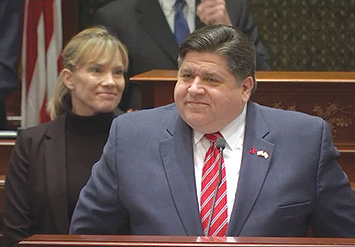
GOV. J.B. PRITZKER at the start of his annual budget address to the Illinois General Assembly.
– IL Department of Central Management Services

Springfield, IL – Illinois unions and supporters applauded Gov. J.B. Pritzker’s annual budget address last ,week, saying it will help balance the budget, create jobs and fund both education and public safety.

State Rep. Jay Hoffman (D-Belleville) said he is looking forward to economic growth and stability.

“As we begin the conversation regarding the budget, my top priority as state representative is to put Illinois, especially the Metro-East, on a path toward long-term economic growth and stability,” said Hoffman, a long-time Labor supporter who is now an assistant majority leader of the House.

“The Metro-East, like all of Illinois, has suffered throughout this pandemic, and I’m committed to supporting infrastructure to improve the economic welfare of the region. The governor’s proposal is an introductory guideline as we look to create a balanced budget, create jobs and fund education and public safety.
“The budget address is only the beginning,” he added. “I look forward to further evaluating the governor’s proposal and getting in contact with my colleagues and community as the budget process progresses.”

One of the state’s largest unions, the Illinois Federation of Teachers, will be watching the budget process carefully, said its president, Dan Montgomery.

“The budget Gov. Pritzker proposed today prioritizes the needs of students and educators and the delivery of public services to our most vulnerable Illinoisans,” Montgomery said. “His proposed $350 million increase is a step toward adequately funding K-12 schools, especially in our neediest communities. But pre-K-12 funding is still billions of dollars short of the Evidence-Based Model funding target, which would provide the resources to educate every Illinois child well, no matter their zip code. We urge Gov. Pritzker and the General Assembly to work toward fully funding the Evidence-Based Model.”

HIGHER EDUCATION TOO
It’s time to better support higher education, too, Montgomery said.

“Critically, the state’s higher education system is suffering from decades of disinvestment,” he said. “We are encouraged by the supplemental FY22 increase in funding for community colleges and universities that carries over to FY23. We urge the legislature to include this vital increase in higher education funding in the final budget.

PAYING THE BILLS
“We also welcome the long-overdue recognition that the state must pay its bills – including the unfunded pension liability,” Montgomery added. “The governor has proposed $500 million in pension funding over and above the required payment. This saves the state money in the long term, and it’s the right thing to do.”

PUBLIC SAFETY
Finally, Montgomery said his union appreciates how Pritzker has worked to keep Illinois residents safe.

“From the start of the pandemic, Gov. Pritzker has steadfastly followed the science to protect our communities and move our state forward,” he said. “We thank him for establishing mask and vaccine mandates that are helping keep our schools open and students and staff safe.

HELPING FAMILIES
State Rep. Katie Stuart (D-Edwardsville), said she was pleased the budget emphasizes helping families.

“Today, the governor proposed a budget with half a billion dollars in surplus to provide financial relief to working-class families. With the proposed surplus, we will meet our full pension liabilities and avoid interest, allowing for huge savings down the line,” she said. “Whether it’s through the proposed freeze on state grocery and gas taxes, the proposed property tax rebate or other measures, this budget proposal is just the beginning of our work to pass real financial relief for those who need it most.”


The Parking Spot

via The Labor Tribune

February 14, 2022 at 07:07PM

Plainfield village trustee to again run for Illinois House seat

https://ift.tt/oTKNdsM

Plainfield Village Trustee Harry Benton announced he will again run for a seat in the Illinois House of Representatives.

Benton, a union ironworker, will run for the Democratic nomination for the 97th District, which includes parts of western Will County, according to a news release. He ran unsuccessfully in 2020 for the same seat against incumbent state Rep. Mark Batinick, R-Plainfield.

“For too long, politicians in Springfield have failed our families and failed to accomplish what people need in their day-to-day lives,” Benton said in a statement. “I am proud to announce my campaign to provide real leadership and representation to what working and middle-class families in our communities deserve.”

Benton cited his work on the Plainfield Village Board as an advocate for small businesses, improving public safety, against higher taxes and improving local infrastructure. Benton was first elected to the Plainfield Village Board in 2019.

This election cycle will feature an open seat in the 97th District since Batinick announced he would not run for reelection.

Two candidates, Tom McCullagh of Shorewood and Michelle Smith, the Plainfield Township clerk, are running for the Republican nomination to the seat.

The 97th District, starting in the 2022 cycle, will include parts of Joliet, Plainfield and Shorewood.

via Shaw Local

February 14, 2022 at 07:04PM

Stuart, legislators call for look into facility safety standards

https://ift.tt/Jvu5diE

EDWARDSVILLE – Responding to safety concerns raised by the Dec. 10 tornado that killed six people when part of an Amazon warehouse collapsed, state Rep. Katie Stuart (D-Edwardsville) and others are seeking ways to avoid a repeat of the tragedy.

On Monday, Stuart and Chairman and Rep. Marcus Evans (D-Chicago), met with various experts during a virtual hearing to discuss warehouse safety standards.

“The death of six workers in the Amazon warehouse collapse calls into question the safety standards of warehouses and the need for tornado shelters or safe rooms in such buildings,” Stuart said. “Many other buildings in our area are built with the same method as the Amazon warehouse and we should be proactive to prevent further tragedies.”

Stuart read a statement by Edwardsville Police Chief Whiteford, who noted that the collapse of the warehouse brought to light concerns about safety and warehouse construction.

“As fire service representatives, we hold the responsibility to enforce minimum standards and advocate for best practices in terms of fire and life safety,” Whiteford said.

“Best practices come from general knowledge, specific training and practical experience, along with combined decades of fire and emergency services. The reality is that most fire codes are based upon tragedies or near-misses. There is a constant balance that needs to be struck between risk versus cost.”

Whiteford noted that the International Code Council (ICC) produces a set of internationally recognized minimum-code standards for construction and that Illinois and most other states follow those standards.

“This tornado highlights the need to review and likely change building requirements for large warehouses,” Whiteford said. “Short of making those changes, the best thing that fire service can do is to improve preparedness.

“Yet equipment is aging, trained personnel are becoming difficult to find and financial resources are spread thin. Response equipment relied on by the state of Illinois, like the mutual box alarm service and the terrorism task force portable shelters, which have been employed across the state for the COVID response, are wearing out. Hazardous materials response vehicles are two decades old and becoming unreliable and costly to maintain.”

Whiteford added that Madison County has more than 30 million square feet of warehouses that are important to the local economy, as well as to national commerce. But providing emergency services to those buildings and other facilities is becoming more of a challenge.

“Six fire departments in western Madison County have self-contained breathing apparatus set to expire next year,” Whiteford said. “Radio communication systems in Madison County are not standardized. In some cases, police and fire in the same town cannot communicate with each other over the radio. This problem expands to communication between counties and becomes even more complicated as it crosses state lines.”

Whiteford also noted that staffing challenges exist within both the career and volunteer side of fire service, and training is another concern. As many firefighters retire and leave the fire service, new hires need expensive technical training.

“Emergency services cannot be seen as operating in the same way that businesses do,” Whiteford said. “Businesses operate on an efficiency model, to do the most you can with the least possible cost. If a business fails, there is an economic cost to the community; if emergency services fail, there are costs in terms of lives, injuries and social and community impacts, as well as the economic impacts.

“Emergency services cannot fail. They are simply too important to the welfare of the community. Emergency services must operate on a resiliency model, and they need built-in redundancy in order to ensure that the response capabilities are there when they are needed.”

Speakers at the hearing included Jim Bell, Director of Operations for the National Storm Shelter Association.

“We suggest that building owners get an architect or engineer who is knowledgeable with tornado codes to do surveys of buildings to see where you would put (storm shelters) within the building, as well as well as the occupancy (standards) for the shelter, as well as the ability of the shelter to hold up,” Bell said.

“Impact debris is what damages a lot of shelters, but with the warehouse in Edwardsville, it looked a lot more like wind damage was working on the roof system and the walls caved in. We’ve learned over the years how tornadoes work, and we try to apply that knowledge and technology to the improvements that we make.”

Marc Levitan, meanwhile, is a research wind engineer for the National Institute of Standards and Technology (NIST).

Levitan noted that most tornado fatalities occur inside buildings, and that the tornado that hit the Amazon warehouse was an EF3 tornado, with 150-mile-per-hour winds.

“The design speeds that we use in the new (building code) standards are 130 miles per hour and that ranges from approximately EF0 to EF2 tornado intensity, and 97 percent of tornadoes are in the EF0 to EF2 range,” Levitan said.

“The design tornado criteria for a particular building depends on its risk category, its geographic location and the building plan, size and shape. The latter is important because the larger the size of the facility, the larger its footprint will be when a tornado strikes. The tornado criteria are not designed to protect against the most intense tornados; they’re designed to protect against the most common tornadoes.”

Other speakers were Randy Harris, director of the Midwest Region for Laborers-Employers Cooperation and Education Trust (LECET); Tim Drea, president of the Illinois AFLCIO; Gavin Stoddard from the International Warehouse Logistics Association and Alex Laird from the Illinois Retail Merchants Association.

Feeds,News,Metro East,City: St. Louis, MO

via news-rss https://ift.tt/NeK182p

February 14, 2022 at 05:58PM

Halpin encourages participation in Rock Island County CASA program

https://ift.tt/LP2R7SO

State Rep. Mike Halpin (D-Rock Island) is encouraging constituents who want to get involved with child welfare advocacy to consider joining a program in the district he represents.

Halpin referenced the program in a recent post on social media. 

"EveryChild (formerly known as the Child Abuse Council) is looking for community volunteers to join their Court Appointed Special Advocates (CASA) program in Rock Island County," Halpin wrote in a Feb. 2 Facebook post. 

Halpin described the CASA program and how it’s beneficial for child victims. 

"CASA is a national network that recruits, trains, and supports community volunteers to advocate for the best interests of children who have been abused and neglected, leading to shorter stays in foster care and more positive outcomes for families," he said.

Halpin provided information on how to get involved in the CASA program so those who think it might be something they’d like to do know where to start.

"If you’re interested in becoming a CASA (advocate) and serving children in foster care within our community, you can learn more and apply by visiting foreverychild.org/casa or by contacting danielw@foreverychild.org," Halpin wrote in the post. 

According to the EveryChild website, the organization aims to prevent child abuse through both community and family-focused education and support. It also provides the necessary resources to help heal trauma. 

The CASA program can be found across the country and works with children in the courts. The website noted that advocates work with children to learn about their everyday life, including how they’re doing in school, at a foster home, or with their parents and then file a report for the judge to consider during court proceedings. 

280 children were in foster care in Rock Island County as of the end of last year, according to Our Quad Cities.

Proft,Feeds

via Rock Island Today https://ift.tt/U9Gpwvz

February 13, 2022 at 10:05AM

Illinois lawmaker hopes to expunge more marijuana arrest records by dropping drug test requirement

https://ift.tt/NeC8inL

SPRINGFIELD (WGEM) – An Illinois House Democrat hopes to help more people get previous cannabis charges expunged from their record. Rep. Carol Ammons (D-Urbana) says some still face a barrier because of the drug test required before expungement.

Recreational marijuana has been legal in Illinois since January 1, 2020. One of the major components of the legalization law was the automatic expungement of nearly 500,000 marijuana arrest records. Although, some people are still waiting to have a clean slate today.

Ammons says people not eligible for expungement right now may be rejected because of marijuana found in their system. She hopes to remove cannabis testing from the requirement for expungement to help speed up the process. Ammons told the House Judiciary-Criminal Committee that many also end up paying an extra $75-$100 to take the drug test while people across the state can legally use cannabis.

“It’s not going the way this legislative body intended it to go,” said Mark Mitchell, an advocate with Teamwork Englewood. “It’s not happening in four months. It’s taking 18-19 months to get this done on the regular.”

Ammons is working with Carbrini Green Legal Aid on an amendment to specifically note that a petition for expungement cannot be denied because of a positive drug test. It would also block courts from denying expungement of someone testing positive.

“We just want to align this bill with what is happening by the billions of dollars in the state of Illinois,” Ammons said. “Cannabis should not be a barrier to expungement if it’s not a barrier to selling it.”

Rep. Patrick Windhorst (R-Metropolis) said he believes the bill’s current language could be interpreted to expand the number of offenses eligible for expungement. Windhorst argues the bill could expand eligibility for people with any felony drug offenses, including the distribution of drugs.

“I understand the intent as it’s been laid out, but I think the bill goes much farther than that,” Windhorst said. “And I couldn’t obviously support expunging all those records.”

Still, Ammons said her proposal will only address the expungement of cannabis records. She emphasized that other drugs will not be added into the language with future amendments to this bill.

“In the future, I may come back to this committee to say that there’s a disparity in drug treatment testing. For instance, if I commit murder you don’t have to do a drug test of any kind before you are eligible for expungement or sealing,” Ammons said. “And think that that’s disproportionate and discriminatory, but I will work on that at a later time. What I’m working on today is strictly cannabis.”

House Bill 4392 passed out of the House Judiciary Criminal Committee Thursday on a partisan 11-8 vote. However, Ammons plans to hold the bill on second reading and bring it back to the committee when the amendments are ready.

Copyright 2022 WGEM. All rights reserved.

via https://www.kwqc.com

February 12, 2022 at 07:01PM

Quad-Cities lawmakers address workforce shortages during chamber forum

https://ift.tt/YIiN4Gr

Local Quad-Cities lawmakers found some common ground, but largely split along party lines on how to help businesses struggling with workforce shortages.

The Quad Cities Chamber of Commerce hosted area state lawmakers at a forum Friday morning at Hotel Blackhawk to provide updates on various policy issues important to area businesses.

Speakers included Iowa Sens. Chris Cournoyer, R-LeClaire; Roby Smith, R-Davenport; and Jim Lykam, D-Davenport; Iowa Rep. Monica Kurth, D-Davenport; and Illinois Reps. Mike Halpin, D-Rock Island, and Tony McCombie, R-Savanna.

“To remain competitive, the Quad-Cities must not only grow our population but create an educated and skilled workforce that attracts new businesses and ensures current employers have the talent pool that they need to succeed,” said Rhonda Ludwig, director of government affairs at the Quad Cities Chamber. “Public policy that fully funds education and skilled-training programs and assists employees with finding affordable housing and childcare will build a well-equipped workforce for our region and employers.”

Iowa House Republicans on Thursday voted to approve a 2.5% increase in per-pupil education funding, providing an additional more than $170 million in supplemental aid for local school districts.

That would equate to an additional $186 per student for the upcoming fiscal year, increasing per-pupil aid to $7,413 for each student.

Lawmakers also passed a separate bipartisan school funding bill that would provide $19.2 million for schools to address inflation and a teacher shortage. The money would help school districts cover the costs of employing paraeducators, substitute teachers, bus drivers and administrative and support staff due to worker shortages.

Kurth and Lykam argue that’s not enough when inflation is running at 7.5%, and say the state — which is sitting on a $1 billion surplus, a $2 billion tax relief fund and nearly $1 billion in cash reserves — can afford more.

House Democrats have proposed raising per-pupil funding by 5%, arguing schools had been underfunded for over a decade.

“And I think when we talk about drawing talent to our state … we need to spend more time taking care of our education if we want to bring people back into our state,” Kurth said. “We are falling behind.”

Cournoyer, a former Pleasant Valley school board member who serves as the chair of the Education Appropriations Budget Subcommittee in the Iowa Senate, disputed Kurth’s claim.

She noted more than 54% of the state’s $8 billion budget goes toward education and argues lawmakers have increased education funding by more than $1 billion over the last decade.

Davenport parent Holly Green, who attended Friday’s forum, echoed Kurth that a 2.5%-increase is not enough.

Green said she wished Republican state lawmakers would “spend their time, energy and money in Iowa on doing things that would help K-12 schools,” rather than advancing bills focused on restricting books, material and curriculum schools or educators distribute that parents deem obscene.

Green, a mother of five, said her oldest is studying to be a teacher.

“Teachers are doing amazing work in our schools across the state,” Cournoyer said to a question from Green about whether lawmakers will support demoralized and burnout teachers, “instead of maybe making their life a little harder.”

“The books that are being discussed have content in them that are extremely sexually explicit,” Cournoyer said. “We’re not talking about banning ‘Tom Sawyer’ of ‘Huck Finn’ or ‘To Kill a Mockingbird.’ We’re talking about books that contain explicit sexual content … and don’t see how it’s relevant or appropriate for K-12 public school libraries.”

Cournoyer also stressed her support for increased funding for Iowa’s community colleges and incentivizing school-based apprenticeships, “where businesses are going in and participating in these STEM and CTE programs and really creating those pipelines into these good-paying jobs.”

Lykam as well said he is focused on supporting apprenticeship programs, as well expanding childcare assistance.

Green, after the meeting, said she wished Iowa lawmakers would give a portion of the state’s budget surplus “back to the schools, which are in desperate need at this time.”

Instead, Iowa Senate Republicans plan to use the state’s taxpayer trust fund to provide tax relief to Iowa families and businesses, Smith said.

Republican proposals would phase in a flat personal income tax of 3.6% to 4% for all income brackets, cut corporate taxes and eliminate taxes on retirement income.

“We’re going to look to give some of the money back to the hardworking taxpayers of Iowa that will retain people here,” he said. “That will attract people here. We’re going to get rid of the tax on pensions so that we keep retirees here in Iowa.”

The varying proposal by House and Senate Republicans would save taxpayers — and thus reduce state revenue — anywhere from $1.7 billion to $2 billion.

Ludwig said the chamber is “inclined to be supportive of a reduction in corporate rates,” but questioned how lawmakers propose to account for lost revenue.

Smith said Republicans would pay for tax cuts using state cash reserves and projected economic growth.

“We also going to fund education like we have, health care like we have and also public safety like we have,” Smith said. “And so I’m confident we will do that.”

Lykam argued Senate Republican’s tax reform plans would primarily benefit high-income earners and may not be sustainable.

“I am all for tax cuts, but I’m also for if those tax cuts are coming down to the middle-class — my constituents,” he said. “If you don’t have that income, then you’re going to have to raise fees on services elsewhere in the budget.”

Democrats instead have proposed increasing the child and dependent care tax credit for working Iowans. They say doing so would reduce the amount people owe in taxes and, in some instances, generate annual tax refunds, effectively cutting taxes for low- and middle-income Iowans.

Halpin and McCombie were asked how they would address rising unemployment insurance costs.

Illinois Gov. J.B. Pritzker’s proposed state budget did not include money to pay down the $4.5 billion the state borrowed from the federal government to keep its unemployment insurance trust fund afloat during the height of the COVID-19 pandemic.

The governor’s office has said negotiations with lawmakers and labor and businesses leaders are ongoing, including using much of about $3.5 billion in remaining federal American Rescue Plan Act funding to pay down the deficit.

McCombie warned that if the state doesn’t take action to pay down the deficit, it could lead to massive unemployment insurance rate hikes on businesses and cuts to benefits for those claiming unemployment.

Halpin said he supports putting much of the state’s $1.7 billion surplus into the unemployment trust fund, “so that cost does not translate into increased cost for business or decrease in benefits for our unemployed workers.”

McCombie added: “It’s extremely important we pay that back. Otherwise, it’s going to cost Illinoians more” either through higher tax rates or reduced benefits.

— Erin Murphy of the Cedar Rapids Gazette contributed reporting to this article

Get Government & Politics updates in your inbox!

Stay up-to-date on the latest in local and national government and political topics with our newsletter.

Feeds,News,Northern

via qconline.com – RSS Results in news/local/govt-and-politics of type article https://ift.tt/91uTOMh

February 11, 2022 at 04:58PM

Complaints about the quality of school lunches have pushed Illinois lawmakers to action

https://ift.tt/Zo86Klz

PEORIA – There have always been complaints about school lunch, but the voices have gotten louder lately.

More than 100 parents recently shared on Facebook with the Journal Star thoughts they and their kids had about lunches in districts across central Illinois. Complaints were not only about taste, but also about food quality and freshness. Many said their children begged for a sack lunch to avoid eating the hot lunch.

One state lawmaker from Peoria has introduced a bill, HB 4813, to help boost the quality of what’s being served in school lunches.

Goodbye, traditional calendar: Peoria school district shortens summer break for 2023

‘She’ll come home hungry’

Lacey Nelton didn’t take her 12-year-old daughter seriously when she first started asking to pack a sack lunch for the noontime meal at Washington Gifted Middle School in Peoria. Then Nelton started hearing others make similar complaints.

“I started seeing photos and I heard from some people in the district that a lot of the lunches aren’t very good,” said Nelton. “So I started to let her take a cold lunch. Some mornings, though, we’re in a rush, so she may not take one, and those are the days that, a lot of times, she’ll come home hungry.”

Packing lunch isn’t a big deal to Nelton, but she realizes it might be more difficult for other families.

“My concern is for the kids with families who maybe can’t afford that and rely on those lunches,” said Nelton.

Jefferson Elementary School principal Kate Wyman, left, helps students spaced out for lunch at the Morton school Friday, August 14, 2020.

Jefferson Elementary School principal Kate Wyman, left, helps students spaced out for lunch at the Morton school Friday, August 14, 2020.

Illinois forces ‘a race to the bottom,’ says lawmaker

In Peoria Public Schools, a majority of the students rely on the free and reduced-cost meal program for both breakfast and lunch. Child hunger is a problem so prevalent in the district that feeding students was a priority even when they weren’t in school during the pandemic. Ironically, it’s that high level of need that may be contributing to the low quality of meals being served in the district, said Illinois state Rep. Jehan Gordon-Booth.

“School districts heavily reliant on free and reduced lunches are forced, as a construct of the school procurement code, to always go with the lowest bidder,” said Gordon-Booth. “We are telling individuals who want to bid for the school lunch contract that the only way that you have the ability to win is that it must be the lowest price. … It is inherently a race to the bottom.”

First and second-graders pick up their school lunches at Limestone Walters Elementary School in Bartonville.

First and second-graders pick up their school lunches at Limestone Walters Elementary School in Bartonville.

Forty-eight other states do not enforce this rule, said Gordon-Booth. The National School Lunch Program, a federal program administered by the U.S. Department of Agriculture, does not require schools to take the lowest bid. In Illinois, the rule is written into the state procurement code.

Being forced to accept the lowest bid constrains school districts from selecting the best-qualified contractors to meet the nutritional needs of students, said Sharon Desmoulin-Kherat, superintendent of Peoria Public Schools.

“The flexibility that would come with the adoption of this proposed act stands to benefit school districts because they will be empowered to choose vendors who provide better services and quality," said Desmoulin-Kherat. “The act will also make it possible for students to be fed wholesome, local, fresh and tasty food from vendors that may not necessarily be the lowest bidders."

More in education: After judge’s order blocks school mask rules, here’s what Peoria-area districts are doing

Gordon-Booth doesn’t know why Illinois created the rule, but learning about it prompted her to write legislation to change state procurement code, eliminating the requirement to accept the lowest bid. She introduced initial legislation in 2019 with the intent to push it forward in 2020, but it got waylaid by the pandemic. HB 4813 was finally filed in the House at the end of January and already has three co-sponsors. Gordon-Booth is asking for public support and said the bill is already popular.

“The support that we have for this bill is unbelievable. It is across the state, it is in communities that I didn’t even realize are dealing with this as an issue,” she said.

Logan Hopper, 6, chomps down on a slice of bacon during lunch at Limestone Walters Elementary School in Bartonville.

Logan Hopper, 6, chomps down on a slice of bacon during lunch at Limestone Walters Elementary School in Bartonville.

In districts not required to choose the lowest bidder, the process of selecting a food supplier can be something even students can participate in, said Gordon-Booth.

“The different companies that may want the business of that school district, they will come in and they will provide the lunches for a full week. You’ll have company A, company B, company C, and they will try to earn the business not just of the school, the administration, but the business of the students,” she said. “This is what I’m seeing happening in some of the suburban communities … but it seems like something that’s so far from reach from us. But why is that? School districts are literally spending millions of dollars on lunches, but we’re forced to take whatever is given because it is free? No.”

Leslie Renken can be reached at 309-370-5087 or lrenken@pjstar.com. Follow her on Facebook.com/leslie.renken.

This article originally appeared on Journal Star: New legislation in Illinois underway to improve school lunches

via Yahoo | Mail, Weather, Search, Politics, News, Finance, Sports & Videos

February 9, 2022 at 06:44AM

Blog at WordPress.com.

Up ↑